OpsHub Integration Manager

No-code integration platform for rich bi-directional sync

OpsHub Migration Manager

Zero downtime migration to tool of your choice

OpsHub Archive Manager

Keep Historical Data, Without Slowing Down Your Tools

OpsHub Migrator for Microsoft Azure DevOps

Migrate or restructure Azure DevOps Instances

OpsHub Data Bridge

Real-time, context-rich data lake for AI or analytics

Discover our story, vision, and impact.

By Domain

Software Development & Agile Engineering

No-code integration across teams & systems

IT Service Management & Customer Support

Enable collaboration between IT, support & business teams

Product Lifecycle Management & Systems Engineering

Connect PLM & engineering teams for smarter products

Requirements Management for Regulated Industries

Ensure regulatory compliance from start to release

Blogs

Explore the latest in technology and best practices

Case Studies

Success stories from the field

White Papers

Actionable insights for your business challenges.

Videos

See solutions in action

EBooks

Learn, plan, and execute with confidence

Press Releases

Official announcements and updates

Webinars

Join discussions that drive results

News Letters

Stay ahead with curated insights

OpsHub Integration Manager

Bidirectional Perforce ALM (Formerly Helix ALM) and Azure DevOps (TFS / VSTS) integration

Automatically sync requirements, defects or issues, test cases, and work items in near real time, so teams stay aligned, updates flow without disruption, and quality never slips through the cracks.

Request a demo

From test management to development workflows. Always in sync.

When Helix ALM and Azure DevOps operate separately, developers plan work items without the latest requirement details. Defects discovered in Helix ALM reach engineering late or without diagnostic context. Teams rely on meetings, spreadsheets, and manual updates to keep both systems aligned.

OpsHub Integration Manager (OIM) connects Helix ALM and Azure DevOps through near real-time bidirectional synchronization. Requirements remain consistent across systems, and defects automatically appear as Azure DevOps bugs with full defect details. Work items stay traceable from requirement through development to test result.

Trusted by the world’s leading enterprises

Why companies of all sizes love OpsHub

Integration that fits your lifecycle processes

OpsHub connects Helix ALM and ADO systems without forcing teams to modify their existing workflows. Whether synchronizing hundreds of test artifacts or millions of lifecycle records across multiple projects, the integration adapts to enterprise scale and complexity.

Secure, scalable, zero-plugin setup

Configure everything in clicks, not code. Deploy and manage syncs through an intuitive UI or API. No scripts or admin-level installs are needed in Helix ALM or Azure DevOps. The integration doesn’t break during system upgrades, doesn’t require reinstallation or reconfiguration, and automatically resumes from where it left off once the system is back online.

The richest lifecycle synchronization available

Integration goes beyond simple field mapping. OpsHub synchronizes comments, attachments, relationships, and artifact hierarchies across the systems. Organizations can also configure advanced mappings, routing logic, and transformation rules to maintain the context required for complex engineering programs.

Why you should integrate Perforce ALM and Azure DevOps

How OpsHub Integration Manager integrates Perforce ALM and Azure DevOps

OpsHub Integration Manager acts as a centralized integration hub that connects Helix ALM with Azure DevOps while maintaining the full lifecycle context across systems.

Helix ALM to Azure DevOps
Requirements, defects, and test cases from Helix ALM synchronize to Azure DevOps as work items along with attachments, comments, and relationships. Engineering teams receive complete requirements and testing context inside their development backlog.

Azure DevOps to Helix ALM
Azure DevOps work items such as user stories, tasks, bugs, requirements, and custom work item types synchronize back to Helix ALM. Development updates, status changes, and bug resolutions become visible to QA and product teams.

Unlike plugins, OpsHub runs externally using secure APIs. No performance hit, no admin risk, and no breakage during upgrades. It adapts to evolving processes, custom fields, and multiple Azure DevOps projects without forcing workflow compromises.

The outcome: Product managers understand how requirements progress through development. QA teams gain real-time visibility into bug fixes and feature delivery.

Engineering teams receive structured requirements and testing insights without leaving Azure DevOps.

How to Integrate Perforce ALM and Azure DevOps using OIM

01

Step

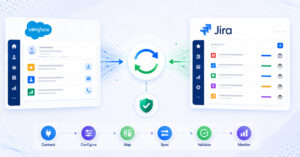
Set up connection to Helix ALM  and Azure DevOps. 
02

Step

Select projects and entities to be synchronized.

03

Step

Define the sync direction and map fields across both systems.

04

Step

Activate the sync and monitor real-time performance via OIM’s dashboard. 
 

Use case: Perforce ALM and Azure DevOps integration

Problem statement

Development teams track work items in Azure DevOps while QA teams manage requirements and test cases in Helix ALM. When requirements change during development, those updates do not automatically reach the QA team. As a result, test cases may be created based on outdated requirements.

Goal

Synchronize requirements and updates between ADO and Helix ALM so development and QA teams always work from the latest requirement details.

Benefits of integration for Perforce ALM and Azure DevOps users

Perforce ALM users

Azure DevOps users

Business value provided

Better Resource
Utilization

0%

Increase in
Customer Satisfaction

0%

Growth in SLA
Turnaround Time

0%

Get started with Perforce ALM and Azure DevOps integration today!