







OpsHub Integration Manager

No-code integration platform for rich bi-directional sync

OpsHub Migration Manager

Zero downtime migration to tool of your choice

OpsHub Archive Manager

Keep Historical Data, Without Slowing Down Your Tools

OpsHub Migrator for Microsoft Azure DevOps

Migrate or restructure Azure DevOps Instances

OpsHub Data Bridge

Real-time, context-rich data lake for AI or analytics

Discover our story, vision, and impact.

By Domain

Software Development & Agile Engineering

No-code integration across teams & systems

IT Service Management & Customer Support

Enable collaboration between IT, support & business teams

Product Lifecycle Management & Systems Engineering

Connect PLM & engineering teams for smarter products

Requirements Management for Regulated Industries

Ensure regulatory compliance from start to release

Blogs

Explore the latest in technology and best practices

Case Studies

Success stories from the field

White Papers

Actionable insights for your business challenges.

Videos

See solutions in action

EBooks

Learn, plan, and execute with confidence

Press Releases

Official announcements and updates

Webinars

Join discussions that drive results

News Letters

Stay ahead with curated insights

Blog

The Coming Divide in Defense: Federation or Fallout Under DoDI 5000.97

The defense industry is entering a pivotal phase with the introduction of DoDI 5000.97, mandating the shift to Digital Engineering (DE). This article examines the challenges, including tool interoperability and data governance, and how suppliers can adapt through Intelligent Federation and integration platforms like OpsHub.

OpsHub Integration Manager

Subversion (SVN) to Azure DevOps integration

Automatically link Subversion commits to their corresponding Azure DevOps (Server and Cloud) work items after code is committed. Developers continue their workflow in Subversion while work items in ADO reflect related commit activity, providing visibility and an auditable history of development work.

Request a Demo

Maintain commit traceability between Subversion and Azure DevOps

Subversion repositories often operate separately from Azure DevOps work tracking, leaving work items without clear visibility into the code changes that implement them. OpsHub Integration Manager (OIM) detects work item IDs in commit messages and links them to the correct ADO work item, capturing commit details including author, timestamp, and message. This ensures work items maintain an accurate history of all associated development activity without altering developer workflows.
Trusted by the world’s leading enterprises

Why companies choose OpsHub

Integration that fits your workflow

No workflow disruption. Developers commit code in Subversion as usual and reference ADO work item IDs in commit messages. OIM links repository activity to the appropriate work items, supporting multiple repositories, projects, and custom configurations without forcing process changes.

Secure, scalable, plugin-free integration

OIM operates externally via secure APIs, eliminating the need to install plugins in Subversion or ADO. It avoids performance impact, functions reliably across upgrades and repository changes, and scales for high-volume development environments.

Clear visibility between commits and work items

Commit metadata including IDs, messages, authors, timestamps, and repository paths appears directly within the related ADO work items. Teams gain insight into how development work maps to tracked tasks, bugs, or features without needing direct access to Subversion.

Why you should integrate Subversion and Azure DevOps

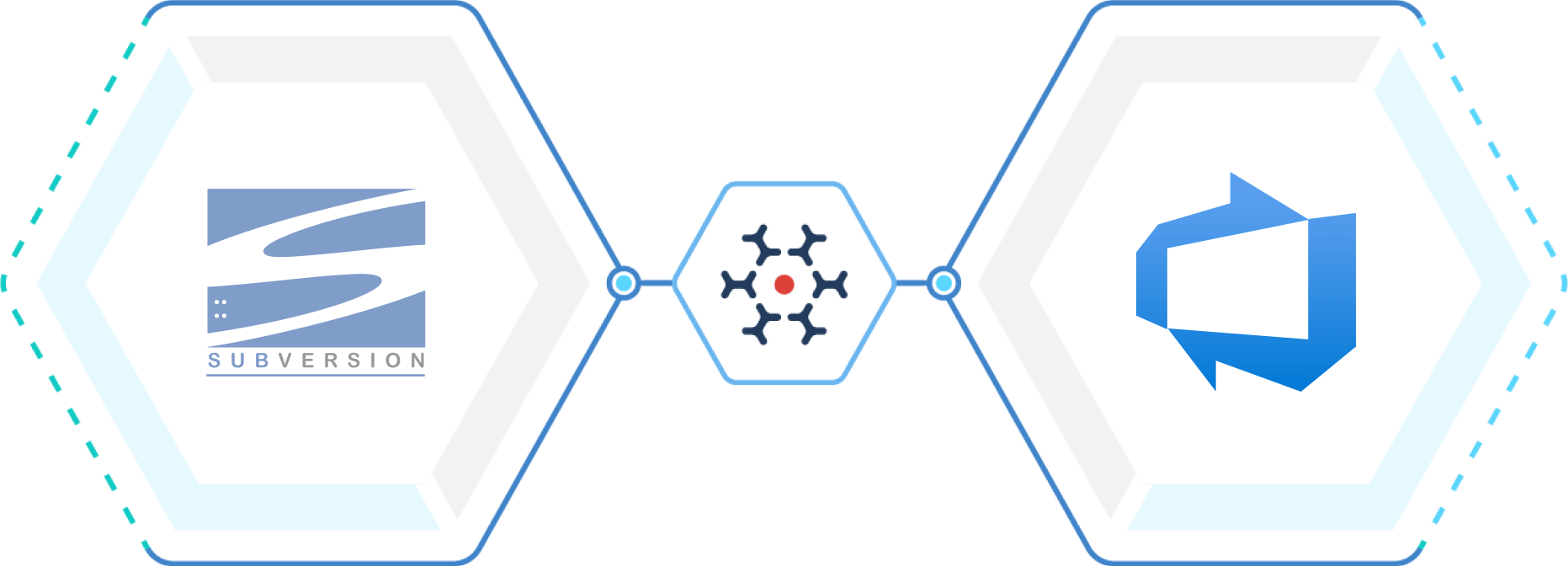
Subversion and Azure DevOps integration linking SVN commits with work items

How OpsHub Integration Manager integrates Subversion and Azure DevOps

OIM is an enterprise-grade integration platform that preserves the context between Subversion commits and ADO work items.

  • Subversion to Azure DevOps: Commit details including ID, message, author, timestamp, and repository path is associated with the referenced ADO work item.
  • Post-commit association only: Developers commit normally in Subversion. OIM links commits to work items after the commit.
  • Secure API-based integration: No plugins, no performance impact, and stable across upgrades or repository changes.

The outcome: Teams maintain visibility into repository activity directly within ADO work items; stakeholders can track progress without accessing Subversion, and organizations preserve a reliable record linking development work and code changes.

Integrate Subversion and Azure DevOps in 4 easy steps

01

Step

Configure Subversion and azure DevOps connections

02

Step

Select projects and entities to integrate  

03

Step

Define synchronization direction and filters  

04

Step

Map fields and activate synchronization 

Use case: Subversion and Azure DevOps integration

Problem Statement

Without integration, Subversion commits remain disconnected from Azure DevOps work items. This makes it hard to track which code changes relate to which work items, slows troubleshooting, and reduces visibility into development progress.

Goal:

Provide a clear, auditable link between Subversion commits and ADO work items so teams can trace how requirements, bug fixes, or enhancements are implemented in code.

Benefits of integration for users

Subversion users

Azure DevOps users

Business value provided

Better Resource
Utilization

0%

Increase in
Customer Satisfaction

0%

Growth in SLA
Turnaround Time

0%

Get started with Subversion and azure DevOps integration today!

Integrate Azure DevOps with these connectors