











OpsHub Integration Manager

No-code integration platform for rich bi-directional sync

OpsHub Migration Manager

Zero downtime migration to tool of your choice

OpsHub Archive Manager

Keep Historical Data, Without Slowing Down Your Tools

OpsHub Migrator for Microsoft Azure DevOps

Migrate or restructure Azure DevOps Instances

OpsHub Data Bridge

Real-time, context-rich data lake for AI or analytics

Discover our story, vision, and impact.

By Domain

Software Development & Agile Engineering

No-code integration across teams & systems

IT Service Management & Customer Support

Enable collaboration between IT, support & business teams

Product Lifecycle Management & Systems Engineering

Connect PLM & engineering teams for smarter products

Requirements Management for Regulated Industries

Ensure regulatory compliance from start to release

Blogs

Explore the latest in technology and best practices

Case Studies

Success stories from the field

White Papers

Actionable insights for your business challenges.

Videos

See solutions in action

EBooks

Learn, plan, and execute with confidence

Press Releases

Official announcements and updates

Webinars

Join discussions that drive results

News Letters

Stay ahead with curated insights

OpsHub Migration Manager

Migrate from Azure DevOps to GitHub with zero downtime

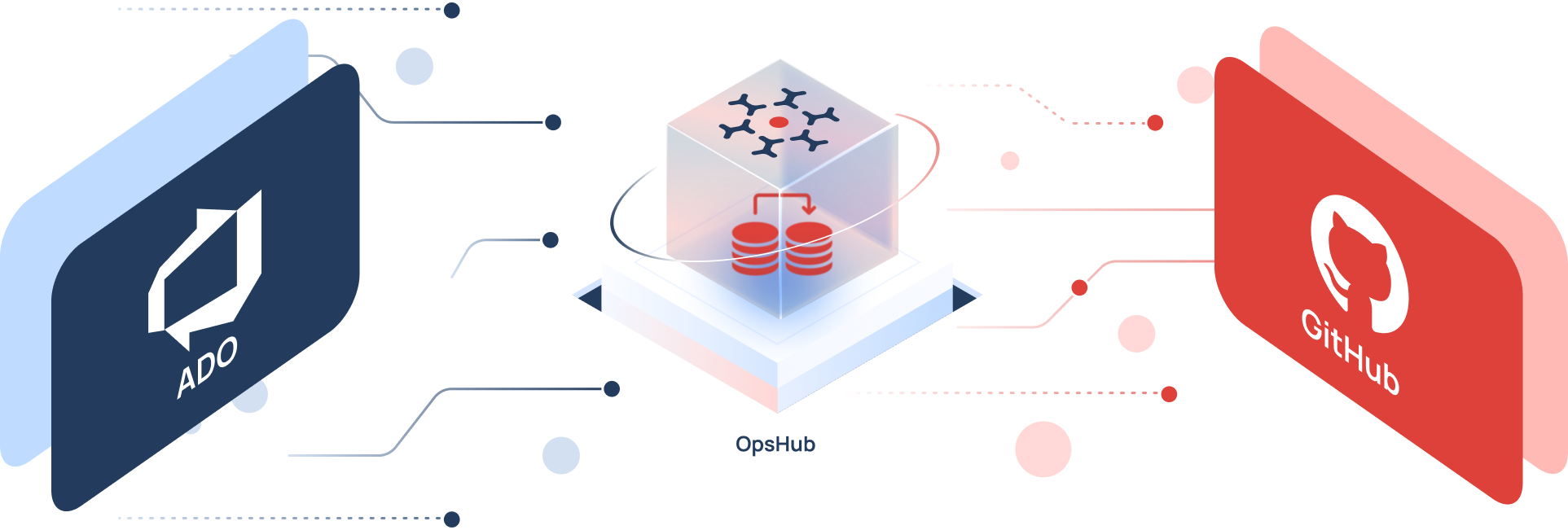
Adopt an AI-native development platform without disrupting delivery. OpsHub Migration Manager (OMM) enables organizations to migrate from Azure DevOps to GitHub while preserving critical history, traceability, and continuity.

ado to github migration

Trusted by forward-thinking teams across the globe

Why organizations are moving to GitHub

GitHub is becoming the strategic platform for modern software engineering, especially for AI-driven development and cloud-native delivery.

AI-Native software development

GitHub integrates AI capabilities across coding, security, and collaboration, with advanced features optimized for repositories hosted on the platform.

Improved developer experience

Familiar pull request workflows and a strong collaboration model support distributed teams and modern development practices.

Platform standardization

Organizations consolidate tooling on GitHub to reduce complexity, improve governance, and standardize engineering practices.

Hybrid Azure DevOps and GitHub adoption

Most large organizations adopt a hybrid model during transition rather than migrating everything at once.

Typical patterns include hosting code in GitHub while planning or delivery processes remain in Azure DevOps, migrating teams in phases, and retiring legacy systems gradually.

Key migration challenges

Moving from Azure DevOps to GitHub involves technical and organizational complexity due to differences in platform structure and operating models.

Structural differences

Azure DevOps projects do not map directly to GitHub organizations and repositories, requiring redesign of structure and governance.

Preserving traceability

Maintaining links between commits, work items, and historical context is essential, especially for regulated environments.

Security and compliance

Permissions, approvals, and audit controls must be re-established in the target system.

Large-scale data migration

Enterprise repositories often contain extensive histories that require careful planning.

Organizational change

Teams must adapt to new workflows, tools, and collaboration models.

Validate your migration approach before you commit

Every environment is different. Ensure your migration plan preserves critical history, maintains traceability, and minimizes disruption.

Use migration as an opportunity to modernize

Azure DevOps environments often accumulate technical debt and inconsistent practices.

Migration is an opportunity to simplify and standardize before moving to GitHub.

Legacy Azure DevOps environment Modernized GitHub environment
Duplicate or inactive repositories
Consolidated repository landscape
Inconsistent naming conventions
Standardized structure
Complex or outdated workflows
Simplified processes
Excess custom fields and schemas
Streamlined issue models
Fragmented documentation
Centralized knowledge
Organic permission growth
Deliberate governance and access control

How OpsHub approaches Azure DevOps to GitHub migration

OpsHub Migration Manager (OMM) treats migration as a structured engineering program rather than a one-time data transfer, enabling controlled transition with minimal disruption.

01

Structured discovery before movement

OMM analyses repository structures, work item hierarchies, custom fields, permissions, and dependencies before migration begins.

02

Mapping that preserves relationships

OMM defines how data will map between systems while preserving context, including hierarchies, custom fields mapped into preconfigured targets, parent-child relationships, and references.

03

Controlled and phased transition

Migration can be executed incrementally by project or team, with validation cycles before full rollout.

04

Rollback readiness

Planned rollback strategies allow teams to revert safely if issues arise during migration.

05

Designed for minimal disruption

With Live+ approach to migration Opshub ensures zero downtime or disruption, allowing teams to continue working during transition.

Why OpsHub Migration Manager for ADO to GitHub migration

Large-scale enterprise migrations require controlled execution and risk management.

Comprehensive data fidelity

OMM migrates repositories, work items, history, attachments, and relationships while preserving context. Critical development data remains usable after migration.

Preservation of traceability

OMM maintains relationships across commits, work items, and planning artifacts. Audit trails and historical context are retained.

Enterprise-scale execution

Designed for large data volumes, multiple projects, and complex organizational structures. This ensures predictable performance for enterprise migrations.


Controlled migration process

Supports phased execution and validation rather than a single one-time transfer. This results in greater operational control and lower risk.

Rollback and recovery capability

Enable recovery without restarting the entire migration, helping teams adapt to issues or evolving requirements.

Minimal disruption to ongoing work

Designed to support migration while teams continue development activities. Business continuity throughout the transition.

Already planning a migration?

Recommended migration process

Successful migrations typically follow a structured lifecycle.

Common migration use cases

What needs to be migrated

Migration scope varies by organization but typically includes the following:

Repositories

Planning Data

Documentation

Artifacts and Packages

Proven across enterprises

Trusted by leaders in technology, aerospace, defence, and healthcare

Start your Azure DevOps to GitHub migration with confidence

Migrating development platforms is a strategic initiative that affects productivity, governance, and delivery capabilities. Expert guidance can significantly reduce risk and accelerate successful adoption.