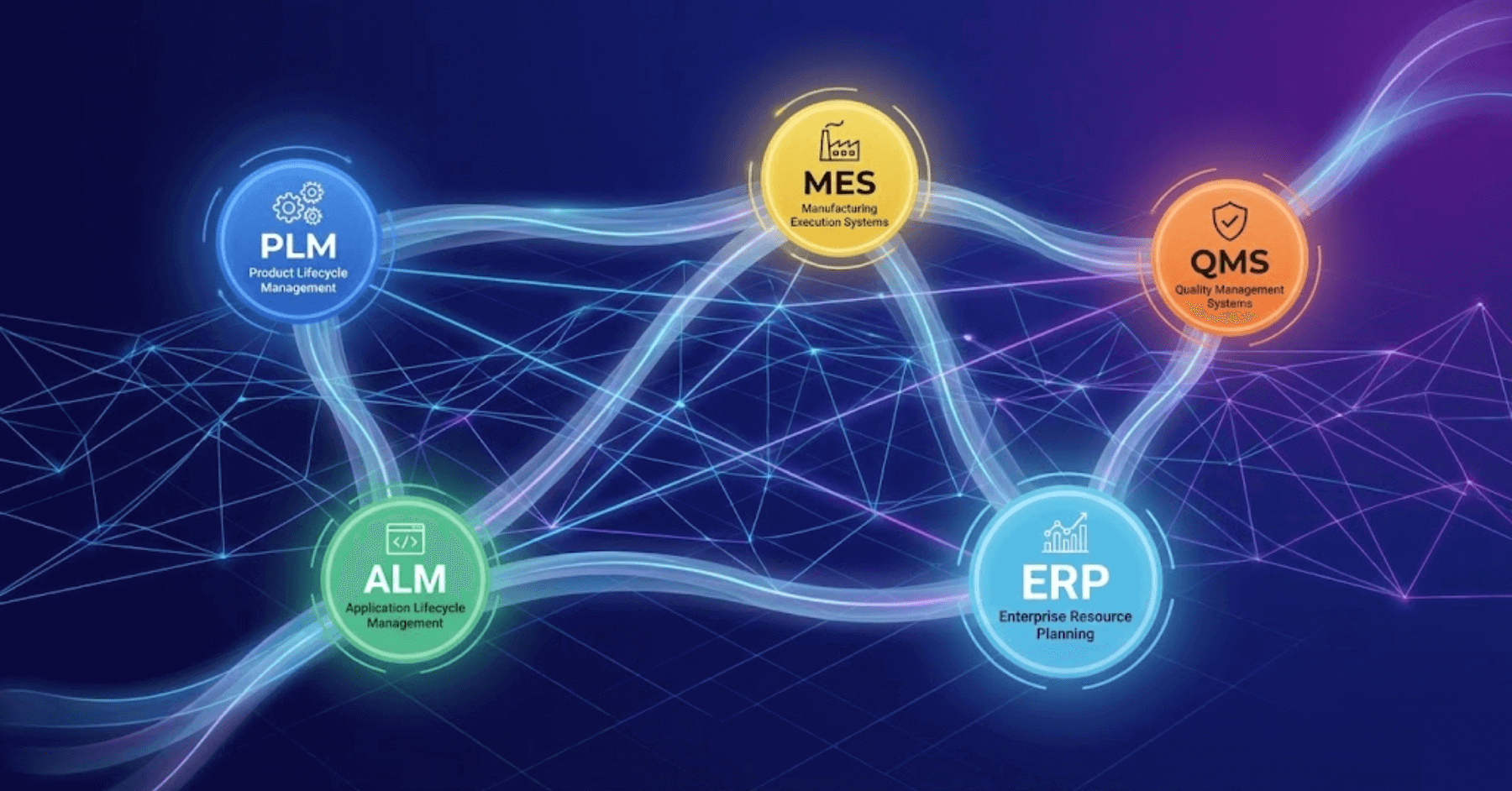
One of the technologies powering Industry 4.0 is the Digital Thread. Estimated to be worth $11.42 billion in 2024, the global Digital Thread market is poised to grow exponentially by 2030. As industries clamour to adopt this data-driven architecture to stay competitive, digital thread implementation challenges inevitably arise. Let’s take a look at these preliminary issues in operationalizing the Digital Thread framework.
What are Digital Threads?
A digital thread is essentially an information-relay framework that offers a comprehensive view of the product life cycle. It involves connecting each stage- product design, manufacturing, distribution, retail, and after sales- into an integrated digital ecosystem. Enterprises thus achieve total visibility into their processes as data and information throughout the product’s lifecycle is made available on a single platform for all stakeholders.
Why do you need to implement Digital Thread?
The purpose of a Digital Thread is to connect the multiple nodes in an organization to enhance collaboration and communication. Digital Threads are helpful in breaking silos and making relevant information available to all departments and functions. A holistic view of all process means that enterprises have actionable insights into:
The end result is maximized profits and greater overall efficiency.
Common Challenges of Digital Thread Implementation
While digital thread solutions promise end-to-end visibility across the product lifecycle, enterprises often face significant challenges during digital thread implementation. Let’s discuss these in detail.
1. Vendor Lock-In
Relying heavily on proprietary systems limits an organization’s flexibility, making it difficult to adapt to changing business needs or explore alternative solutions. This reliance can also result in increased costs, as vendor lock-in reduces options for negotiation and leaves businesses exposed to potential price increases. Furthermore, organizations become dependent on single vendors, which makes them vulnerable to disruptions like product discontinuations or financial instability on the vendor’s part.
2. Complexity of Integrating Legacy Systems
Digital transformation is offering new avenues but also posing a challenge to current practices. The pushback comes in two forms- employee resistance to change and difficulty integrating with legacy systems. The former can be overcome by maintaining transparency with the team and empowering them to realize the benefits. The latter presents a more daunting scenario.
Legacy operating systems, ERPs, CRMs, and other formats may be incompatible with the new technology. This leads to complex and time-intensive data migration and conversion processes. If not integrated correctly, these can obstruct the workflow and cause implementation delays.
3. Data Silos and Fragmentation
When using legacy systems, different departments in an enterprise use varied formats, naming conventions, and standards. This creates isolated data silos that are often inaccessible to other teams. Also, very often data is stored on different systems and databases leading to fragmentation. In such scenarios, implementing a Data Thread may prove difficult due to interoperability issues across different formats. A deep understanding of the organizational systems and professional expertise is required to standardize and consolidate the dispersed data on a single network accessible to all.
4. Security and Compliance Concerns
Digital transformation is accompanied by the problem of cybersecurity. As the entire enterprise data shifts to a centralized location or cloud, safeguarding it from deliberate/accidental breaches becomes a concern. While legacy systems were more prone to data security concerns, the need for data protection cannot be ignored. With cyberattacks on the rise, enterprises are becoming more aware of the need for data safety. As digital threads make all organizational information available across teams and external stakeholders, IP concerns and safety hurdles are bound to occur. Adhering to the requirements of regulatory compliances like General Data Protection Regulation (GDPR) must also be taken into consideration when executing Digital Threads in enterprises.
5. Scalability and Maintaining Data Continuity
Handling the novelty of digital transformations can put increased demands on the organisational infrastructure. This may cause compromised performance and output. If data sync is not rich like syncing rich content, including links and hierarchies, then it can lead to incorrect decision making, compliance issues and delays.
How to overcome digital thread implementation challenges?
All the above obstacles are mere teething issues that occur with the integration of new technology. Below are the best practices to follow when implementing a Digital Thread:
Conclusion
The challenges to implementing a Digital Thread are dwarfed by the immense benefits it offers to an enterprise. But simply implementing them without tailoring the requirements to your organisation’s needs can be counterproductive. It is therefore advisable to work with a data integration partner that offers enterprise grade, customised, end-to-end solutions. This ensures a sustainable strategy for businesses looking to extract maximum value from their digital thread initiatives.