TL;DR: Point-to-point integrations work for a single, stable connection between two tools at small scale. Once your toolchain grows to three or more platforms, a central integration hub delivers configuration-driven ease of use, scalability across growing environments, and the full data richness that regulated industries require. OpsHub Integration Manager is purpose-built for that hub model across ITSM, DevOps, ALM, and PLM toolchains, and is designed to deliver reliable and rich data sync across every connection it manages.
Which integration approach actually fits your toolchain?
If you are connecting exactly two tools for few projects and that connection is unlikely to change, point-to-point can get you moving fast. But most organizations connecting tools like Jira, Azure DevOps, Zendesk, IBM DOORS, or PLM platforms are not dealing with a single pair of systems. They are dealing with a toolchain, and that changes the calculation entirely.
Point-to-point integration creates a direct, custom link between two specific systems. It has no intermediary, no shared configuration layer, and no central place to manage business logic. That simplicity is its main appeal, and also its main liability at scale.
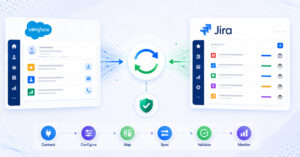
A central integration hub sits between all your tools and manages every connection from one place. Each new system connects to the hub rather than to every other system individually. Business logic, field mappings, workflow states, and synchronization rules are defined once and applied consistently. When a tool is upgraded or replaced, you update one connection in the hub rather than every downstream script that touches that tool.
For organizations in healthcare, manufacturing, finance, aerospace, or defense, where integration failures carry compliance and operational risk, the architectural choice between these two models is not a technical preference. It is a business continuity decision.
What are the real costs of point-to-point integrations at scale?
Point-to-point is cheap to start and expensive to sustain. The math makes the problem concrete: connecting 10 systems point-to-point can require up to 45 separate connections. A hub-and-spoke model reduces those same 10 systems to 10 connections, one per system into the hub.
Each point-to-point connection is typically a custom script or a narrow native connector. That means:
- Developer dependency. Every change to a field, workflow state, or data model requires a developer who understands that specific script. Team turnover becomes an integration risk.
- Cascading fragility. A change to one system can silently break downstream connections. A custom script written against an older API version may behave unexpectedly after a platform upgrade. Some platforms provide upgrade preview tooling that can flag conflicts in advance, but these do not catch every compatibility issue across custom integrations.
- No shared context. Each script sees only the two systems it connects. Relationships, hierarchies, parent-child structures, and cross-tool traceability have to be rebuilt manually for each link.
- Audit gaps. In regulated environments, point-to-point scripts rarely produce the configuration audit trail or change history that compliance teams need.
- Distributed debugging. When data breaks, there is no single place to look. Each link is its own black box, so tracing a failure means hopping between systems and stitching together logs that share no common format or transaction ID.
Custom scripts also struggle with the data richness that modern support and engineering handoffs depend on: comments with @mentions, inline images, attachments, test case hierarchies, and multi-level work item structures all require logic that goes well beyond field copying. When that logic lives in a dozen separate scripts, consistency is impossible to guarantee.
What does a central integration hub actually give you that scripts cannot?
A purpose-built integration hub manages the full complexity of connecting toolchains from a single, auditable configuration layer. The core difference is not just fewer connections. It is what those connections can carry and how reliably they carry it.
OpsHub Integration Manager connects 70+ tools across ITSM, DevOps, ALM, and PLM categories, including Jira, Azure DevOps, Zendesk, Salesforce, IBM DOORS, PTC Windchill, Aras Innovator, Jama, GitHub, and more. The platform is configured through a no-code graphical interface, so integration logic is visible, auditable, and editable by the team responsible for it, without requiring a developer to interpret a script every time something changes.
Three capabilities consistently separate a hub like OpsHub Integration Manager from point-to-point approaches:
Ease of use through configuration-driven mapping. Field-level mapping, workflow state translation, and synchronization rules are configured visually, not coded. A support operations team can see exactly how an incident state in one tool maps to an issue status in another, change it, and redeploy without writing a line of code.
Data richness across every sync. OpsHub Integration Manager synchronizes history, attachments, comments with @mentions, inline images, worklogs, rankings, parent-child relationships, and test data, not just basic fields. When an engineering team resolves an issue in Azure DevOps, the linked ticket in the connected support platform gets the full update, including context and history, not just a status flag with everything else stripped out.
Scalability for growing environments. Because every tool connects to the hub, adding a fourth or fifth system does not multiply your integration footprint. You add one new connection and inherit the existing business logic framework. Organizations including Carl Zeiss, Daimler Truck, Bosch, Nestlé, EY, and Deloitte rely on this architecture when their toolchains span multiple teams, time zones, and regulatory boundaries.
This architecture is also designed to deliver zero disruption and zero downtime: teams in every function continue working in their native tools while data moves reliably and continuously across the hub, without manual exports, maintenance windows, or integration-driven outages.
A comparison of leading ALM, DevOps, ITSM, and PLM toolchain integration providers covers how different platforms handle these requirements in practice.
Are native connectors a safe middle ground?
Native connectors offer a faster path than custom scripts and carry vendor support. They are a reasonable starting point for simple, two-tool workflows. But they carry their own constraints that become friction at scale:
- They typically cover only the specific tool pairing they were designed for. Expanding to a third tool means a separate connector with a separate configuration.
- They are controlled by the vendor’s product roadmap. If one platform changes its data model, the connector update may lag or may not preserve your custom field logic.
- They rarely synchronize the full data model: test cases, hierarchies, custom workflow states, and rich text fidelity are commonly absent or partial.
Before replacing a native connector with a purpose-built platform, the questions to ask integration vendors about data fidelity, security, and workflow sync offer a useful evaluation framework.
How do integration platforms in the market compare on this architectural question?
The toolchain integration market spans several categories. Understanding where each sits on the point-to-point vs. hub spectrum helps clarify the trade-offs.
Purpose-built toolchain integration platforms are built hub-first, with pre-built connectors that understand the data models of specific tools. They handle bidirectional synchronization, conflict resolution, and rich data fidelity without requiring custom code. OpsHub Integration Manager is an example of this category, connecting 70+ tools with a no-code configuration layer built specifically for ITSM, DevOps, ALM, and PLM toolchains.
Value stream management platforms take a hub approach focused on software delivery integration across planning, engineering, testing, and support toolchains. These platforms are strong for traceability and delivery metrics across development pipelines. Organizations should evaluate current tool coverage, deployment options, and data-isolation capabilities directly with the vendor, as these vary and are updated regularly.
No-code/low-code automation platforms (such as Workato) offer broad automation coverage across hundreds of business applications, with purpose-built connectors for many ITSM and DevOps tools. They are well suited for general business process automation. OpsHub Integration Manager goes further for engineering toolchain scenarios by providing ALM-grade data richness: continuous bidirectional synchronization, full history and hierarchy preservation, relationship integrity across linked work items, and complex workflow state mapping designed specifically for development and support workflows at scale.
Narrow connectors and point-to-point scripts are exactly what the name suggests: fast to deploy for one specific pairing, but costly to maintain as the toolchain grows and tools are upgraded.
OpsHub’s position in this landscape is specific: built for organizations that need hub-architecture reliability with data richness and field-level control that ITSM-to-DevOps handoffs require, and that cannot absorb integration failures. It also supports on-premise and private cloud deployments, a requirement for regulated industries where data cannot transit a shared cloud environment.
For teams evaluating specific tool pairings, a detailed comparison of integration tools for ServiceNow or Zendesk to Jira and Azure DevOps handoffs covers how the leading options stack up on the criteria that matter most.
When does point-to-point integration still make sense?
Point-to-point is the right choice in a narrow set of circumstances:
- You are connecting exactly two tools for only couple of projects, both of which are stable, with no plans to add a third.
- The integration is simple: one entity type, a small set of fields, no relationship or hierarchy sync required.
- The connection is temporary, for example, a short-term project bridge that will be retired when the project ends.
- Your team has dedicated developer capacity to maintain the script and monitor it through every tool upgrade.
Outside those conditions, point-to-point introduces compounding technical debt. The hidden cost is not the first script. It is the fifth, the tenth, and the maintenance cycle when any one of the tools in your stack upgrades its API.
When should you move to a central integration hub?
Move to a hub model when any of these conditions apply:
- Your toolchain includes two systems to be integrated for large number of projects along with data richness
- Your toolchain includes three or more systems that need to share data with each other.
- You need to synchronize workflow states across tools with different status models, not just copy fields, because the business process spans those differences.
- Your data includes relationships, hierarchies, test cases, attachments, or comment threads that need to remain intact across systems.
- You operate in a regulated industry where integration configuration must be auditable and access to synchronized data must be permission-controlled.
- Your tools are upgraded on a regular cycle and you cannot afford retesting and rewriting scripts after every upgrade.
- Teams in different functions including support, engineering, product, and compliance all need visibility into the same work item from their own native tool.
The last point matters in particular for cross-functional handoffs. Consider a scenario where a product defect is tracked in Jira, linked to a support ticket in Zendesk, and tied to a compliance requirement in IBM DOORS. Each team needs the same context, status, and history, without being forced out of their own tool. That kind of multi-directional, cross-functional synchronization is where a hub architecture proves its value, and where point-to-point scripts consistently fall short.
For teams managing support-to-engineering handoffs specifically, the best integration tools for ServiceNow, Jira, and Azure DevOps workflows covers how to evaluate the leading options.
OpsHub Integration Manager is designed for exactly these scenarios, extended across 70+ tools and available on-premise or in a private cloud for organizations where data sovereignty is non-negotiable. OpsHub’s compliance-first data integration capabilities are particularly relevant for aerospace, defense, healthcare, and financial services teams that need both integration reliability and a full audit trail.
Frequently asked questions
How many connections does a hub model actually save compared to point-to-point?
Connecting 10 systems point-to-point requires up to 45 separate connections, one for every unique system pair. A hub model reduces those same 10 systems to 10 connections, since each system connects only to the hub. At 5 systems, point-to-point requires up to 10 connections; a hub requires 5. The gap widens every time a new tool is added, which is why the architectural decision becomes more consequential the larger your toolchain grows.
What happens when a sync fails in a hub model vs. a point-to-point script?
In a point-to-point script environment, a sync failure is often silent. The script may time out, skip a record, or partially update a field without alerting anyone. Formatting breaks, @mentions stop resolving, relationships drop, and the two systems quietly drift out of sync. Teams discover the problem only when a ticket is lost or a status is wrong at the wrong moment. A purpose-built hub platform surfaces failures immediately, retries on a defined schedule, and logs every event so the operations team can identify and resolve the root cause without manually auditing every affected record. For teams running multi-directional sync across three or more tools, undetected failures in one link compound across the others, making visibility into sync health a critical operational requirement, not an optional feature.
How does a hub handle complex workflow state mapping across tools with different status models?
This is one of the most practically important capabilities to evaluate when choosing an integration approach. Different tools use fundamentally different status vocabularies. A ticket that is “Pending Customer” in a support platform may need to map to “Waiting for Info” in a project tool and “On Hold” in an engineering backlog, with each transition triggering different notifications or SLA rules in its target system. A point-to-point script handles this with hard-coded conditional logic that breaks every time a workflow is updated in either system. A hub platform with a configuration-driven state mapping layer lets you define these translations visually, update them without redeployment, and apply them consistently across every integration that touches those workflow states. OpsHub Integration Manager handles this through its no-code field and state mapping interface, where operations or integration teams can define exactly how each status in one tool translates to each status in another, including conditional logic for different issue types, priorities, or team contexts. When a workflow state is added or renamed in one of your tools, the mapping is updated in one place and the change propagates across every connected integration immediately. This prevents the silent drift that causes reporting inaccuracies, missed SLA escalations, and compliance gaps in regulated environments.
How do I know if my toolchain has outgrown point-to-point?
The clearest signal is maintenance load. If your team spends recurring developer time patching scripts after tool upgrades, rebuilding broken field mappings, or manually reconciling data between systems, your toolchain has outgrown point-to-point. Other signals include growing compliance audit requests that your scripts cannot answer, onboarding a new tool that requires new scripts for every existing integration, and support or engineering teams working from different versions of the same work item because sync is delayed or incomplete. If any of these apply, the questions to ask integration vendors before replacing a native connector is a practical starting point for evaluating your options.
Talk to OpsHub to discuss how OpsHub Integration Manager fits your toolchain and team size.