Legacy tools were once mission-critical, but technological evolution has made them museum-worthy! According to a 2023 SnapLogic survey, 75% of decision makers said that their teams spend 5 to 25 hours a week updating and patching legacy systems. This is in addition to the huge annual costs of maintaining these obsolete monoliths.
Besides being a drain on resources, legacy tools are a hindrance to your company’s tech ambitions (think generative AI and CoPilot). A large chunk of these systems are incapable of supporting AI tools and workloads. With the future being AI, you definitely don’t want to be stuck in the past!
Let’s explore why modernizing legacy systems is critical for enterprises aiming to enhance operational efficiency, security, and scalability, and the challenges that hinder this transition.
The Real Challenge: Legacy Tools = Data Lock-In
The reliability of legacy tools in the past has made them a repository of data. From mainframes and QC/ALM systems to aging CRM and PLM platforms, enterprise teams rely on legacy tools that still hold mission-critical information.
Most of these systems are built on outdated programming languages and lack interoperability. As data volumes grow, real-time processing becomes crucial, and security risks increase. This traditional architecture fails to keep up.
The result- enterprises struggle to leverage AI’s data-driven insights and risk falling behind competitors.
What “Modernization” Should Actually Mean
The move from legacy to modern systems should be a smooth transition rather than a “tearing apart” of your existing tools. Not only is the “rip and replace” strategy expensive, it also poses a risk to your data.
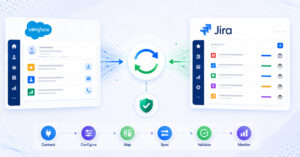
The better alternative? Migration. Instead of disrupting your processes, opt for gradual migration to modern platforms like Azure DevOps, Jira, GitHub, ServiceNow etc.
This phased transition method systematically modernizes business components while keeping critical functionalities operational. For enterprises working in highly regulated environments, this approach allows for continuous monitoring throughout the process.
Migration Challenges That Stall AI Enablement
If the migration approach aligns with your business objectives, the next step is to figure the means. Regardless of which strategy you opt for, migration is a complex process.
Manual migration may seem like a quick fix but is not a reliable, long-term strategy.
Here are the risks you may face with manual migrations:
The result? AI systems trained on incomplete or corrupted data—leading to unreliable insights, skewed predictions, and failed automation attempts.
The Fastest (and Safest) Way to Modernize
The best practices to modernize involve preparing your enterprise for a future where AI is embedded in every decision, every workflow, and every customer experience.
Here’s how to ensure your systems embrace AI:
Real World Examples
A large global enterprise in the manufacturing sector was stuck with HP ALM—a tool critical to QA and compliance, but completely incompatible with their new AI-driven DevOps strategy. To modernize, the enterprise needed to migrate voluminous data and test cases which presented a big challenge.
They trusted OpsHub with the complex task of migrating to Azure DevOps without losing any traceability, user stories, or test cases. The results?
OpsHub Migration Manager not only automated and monitored a safe migration, it ensured that the enterprise had a data architecture robust enough to support AI.
Why OpsHub Migration Manager Is Built for This
Migrations are complicated, but the OpsHub Migration Manager (OMM) is equipped to handle everything that could possibly disrupt the process. There are no unknown elements for this tool that is purpose-built to solve legacy-to-modern migration for complex enterprises!
The added advantage is that it can support a wide range of both legacy and modern tools, including HP QC/ALM, Rational tools, Jira, Azure DevOps, and more.
OMM is agile and dependable. Here’s why:
Final Thought
AI models make the best of the inputs they receive. If you expect them to deliver reliable insights, you have to feed them quality data. Without the right data foundation, even the most advanced AI models are doomed to failure.
Tool modernization is the first step your enterprise needs to take to benefit from the capabilities of AI. Modernization isn’t just a technical upgrade; it’s a strategic enabler for enterprise transformation. Start with the data. Migrate smart. Build for the future!