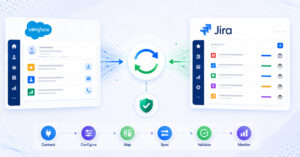
In IBM DOORS Next Generation, we begin by creating a software requirement (00:03). Next, we update it with a formatted bullet list and set the software requirement priority to high (00:10). An inline image is also added (00:17). We then create a system requirement and add the details just as we did earlier (00:26). To meet the sync criteria, we set this priority to high as well (00:32). Now, we update the information in the system requirement, demonstrating how OpsHub Integration Manager syncs updates live between DOORS NG and Azure DevOps (00:40). We then open the software requirement in DOORS NG and update its title and formatted content (00:49). Next, we create a link between the software and system requirements in DOORS NG (00:59). OpsHub Integration Manager runs in the background, fetching data from IBM DOORS Next Generation and automatically syncing it to Azure DevOps with no coding or manual effort required (01:05). In Azure DevOps, both the system and software requirements have now synced successfully (01:14). Under the system requirement, we can see the updated description reflected in Azure DevOps, along with the DOORS system requirement ID and URL, providing direct visibility between the two systems (01:23). Since the status remained unchanged in DOORS NG, it still appears as new. We now change it to active (01:32). As defined in OpsHub Integration Manager, this status update bidirectionally syncs back to DOORS NG as playback, and the link created with the software requirement is also preserved during sync (01:41). Now, let’s take a look at the software requirement. The rich text added in DOORS NG is reflected in Azure DevOps, preserving both formatting and the inline image (01:58). The link created between the requirements is also preserved (02:07). The DOORS software requirement ID and URL are populated as well, enabling direct access from Azure DevOps without switching tools (02:13). Next, we update the software requirement status to active (02:22). We then return to DOORS NG to verify the updated status sync. In the system requirement, the status has changed to playback after the successful two-way sync, and similarly, the software requirement status also updates to playback to reflect the change (02:30). That completes the demo. Thanks for watching (02:42).