













OpsHub Integration Manager

No-code integration platform for rich bi-directional sync

OpsHub Migration Manager

Zero downtime migration to tool of your choice

OpsHub Archive Manager

Keep Historical Data, Without Slowing Down Your Tools

OpsHub Migrator for Microsoft Azure DevOps

Migrate or restructure Azure DevOps Instances

OpsHub Data Bridge

Real-time, context-rich data lake for AI or analytics

Discover our story, vision, and impact.

By Domain

Software Development & Agile Engineering

No-code integration across teams & systems

IT Service Management & Customer Support

Enable collaboration between IT, support & business teams

Product Lifecycle Management & Systems Engineering

Connect PLM & engineering teams for smarter products

Requirements Management for Regulated Industries

Ensure regulatory compliance from start to release

Blogs

Explore the latest in technology and best practices

Case Studies

Success stories from the field

White Papers

Actionable insights for your business challenges.

Videos

See solutions in action

EBooks

Learn, plan, and execute with confidence

Press Releases

Official announcements and updates

Webinars

Join discussions that drive results

News Letters

Stay ahead with curated insights

OpsHub Migrator for Microsoft Azure DevOps (OM4ADO)

TFS to Azure DevOps migration with zero downtime

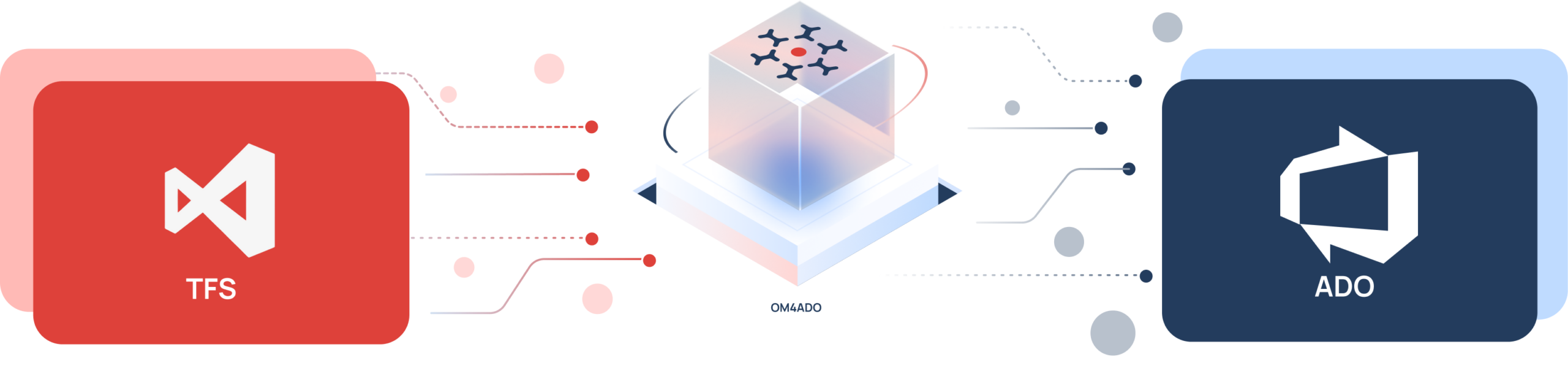
Move from Team Foundation Server (TFS) directly to Azure DevOps Server or Services with full TFVC history, work items, and traceability while teams continue working without disruption.

OpsHub Migrator for Microsoft Azure DevOps (OM4ADO)

TFS to Azure DevOps migration with zero downtime

Move from Team Foundation Server (TFS) directly to Azure DevOps Server or Services with full TFVC history, work items, and traceability while teams continue working without disruption.

TFS to ADO migration

Trusted by forward-thinking teams across the globe

Why TFS to Azure DevOps migration is complex

Modernizing TFS involves years of tightly connected DevOps data.

TFVC history risk

Years of TFVC branches, merges, and changesets must move accurately. Losing version history breaks traceability and creates compliance concerns during audits.

Linked artifact complexity

Work items connect to builds, releases, repositories, and test cases. If relationships break during migration, teams lose visibility across delivery pipelines.

Custom template conflicts

Many TFS deployments use customized fields and workflows. Misaligned templates in Azure DevOps can corrupt data or cause incomplete migrations.

Identity mapping challenges

Users, permissions, and groups must map precisely. Incorrect identity alignment results in broken ownership and restricted access post-migration.

Downtime freeze risk

Pausing development for migration disrupts delivery timelines. Large organizations cannot afford extended system freezes.

Enterprise scale complexity

Thousands of work items, repositories, and attachments increase migration risk. Small inconsistencies quickly multiply at enterprise scale.

Complete TFS migration with OM4ADO

OpsHub Migrator for Microsoft Azure DevOps (OM4ADO) executes legacy modernization as a structured, zero-risk transition & not a one-time export.

01

Zero downtime execution

Teams continue working in TFS while migration runs in parallel. Development does not stop during transition.

02

Incremental delta sync

After initial migration, only new or changed data syncs automatically. This enables safe validation before final cutover.

03

Phased migration execution

Execute migrations in controlled waves. Move selected projects, validate, then proceed, reducing big-bang risk and aligning timelines with business priorities.

04

Selective project migration

OM4ADO lets you migrate selected projects from each source instance in phases, moving what’s ready now and reducing big-bang risk.

05

Identity preservation model

Users and groups are mapped carefully to maintain traceability, ownership, and access control across environments.

06

Cross-version data transfer

Move data seamlessly across Azure DevOps or TFS versions and platforms while preserving integrity, history, and traceability throughout the migration process.

What gets migrated - Complete entity coverage

Modernize TFS without disrupting your delivery

Schedule a free 30-minute live demo with our Azure DevOps migration experts to see how Opshub handle TFS modernization.

5 Steps to migrate from TFS to Azure DevOps

Connect environments securely

Link TFS and Azure DevOps using secure credentials.

Define migration scope

Select projects, repositories, and entities to migrate.

Map identities templates

Align users, permissions, and process configurations.

Execute migration sync

Run initial migration and enable incremental sync.

Validate cutover transition

Verify integrity and smoothly transition active teams.

Proven across enterprises

Trusted by leaders in technology, aerospace, defence, and healthcare

Plan your TFS to Azure DevOps modernization

Book a free 30-minute consultation with our Azure DevOps migration experts. We'll assess your TFS environment and design a risk-free migration roadmap.