OpsHub Integration Manager

No-code integration platform for rich bi-directional sync

OpsHub Migration Manager

Zero downtime migration to tool of your choice

OpsHub Archive Manager

Keep Historical Data, Without Slowing Down Your Tools

OpsHub Migrator for Microsoft Azure DevOps

Migrate or restructure Azure DevOps Instances

OpsHub Data Bridge

Real-time, context-rich data lake for AI or analytics

Discover our story, vision, and impact.

By Domain

Software Development & Agile Engineering

No-code integration across teams & systems

IT Service Management & Customer Support

Enable collaboration between IT, support & business teams

Product Lifecycle Management & Systems Engineering

Connect PLM & engineering teams for smarter products

Requirements Management for Regulated Industries

Ensure regulatory compliance from start to release

Blogs

Explore the latest in technology and best practices

Case Studies

Success stories from the field

White Papers

Actionable insights for your business challenges.

Videos

See solutions in action

EBooks

Learn, plan, and execute with confidence

Press Releases

Official announcements and updates

Webinars

Join discussions that drive results

News Letters

Stay ahead with curated insights

OpsHub Discovery Tool for Azure DevOps

About Utility

This utility is used to get the work item details, Version Control Changeset details, template mismatch details, and user mismatch details. These details will help us to estimate the migration duration.

  • Prerequisites for Utility:
    .Net Framework 4.0 or above (You can download it from here)
    This utility is compatible for TFS 2012 version and above.

Note:Check your access level before running the utility. The recommended access level is Basic or above. The data you can analyze is limited depending upon your access level. For details, please refer here

  • Data Calculation Areas:
    1. Work item Calculation
      1. Get work item count and revision count of each work item type and test entities, along with count for queries, dashboards, widgets, pipelines and Git pull requests for the selected projects.
    2. Version Control Changeset Calculation
      1. Get a total number of changesets, total number of labels, repository size, files and folder count for TFVC, commits and size related information (files and folder count) of Git repositories for the selected projects (if any).
    3. Process Template Mismatch Between Source and Target Projects
      1. Find the process template mismatch between two same–named projects of source and target endpoints.
    4. Find the User Difference
      1. Find the total number of users in source and target projects.
      2. Find the matching users between source and target projects.
      3. Find the user differences if the count of users differs in source and target projects.

Steps to Run the Utility:

Step 1

Start the Utility:
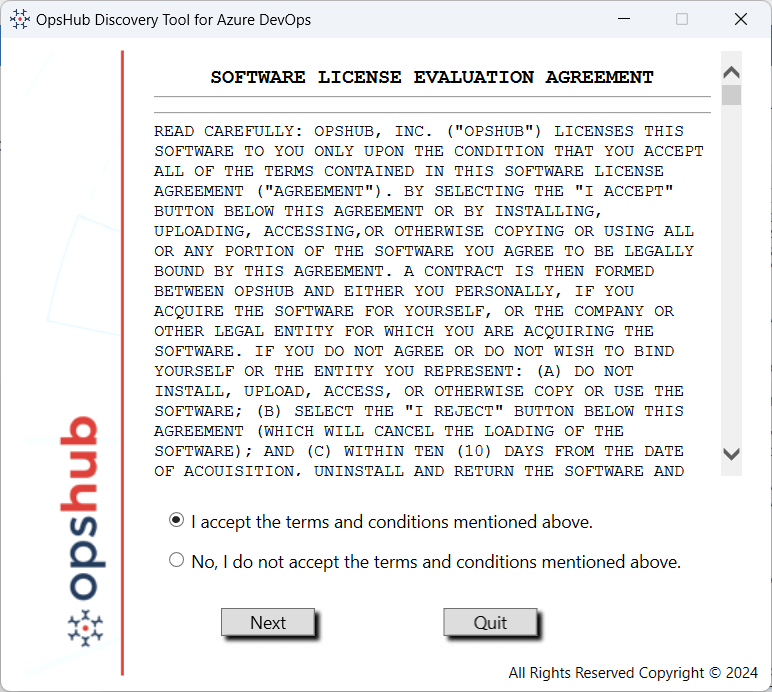
To start the utility, you need to run the DiscoveryUtilityUI.exe file from the utility extracted folder. This will open a EULA [End User License Agreement] screen.

Step 2

Read and Accept the EULA:
Read the license details and accept the same by clicking the option, I accept the terms and conditions mentioned above. Once the EULA is accepted, the next screen appears.

Step 3

Select the Analyzing Purpose:
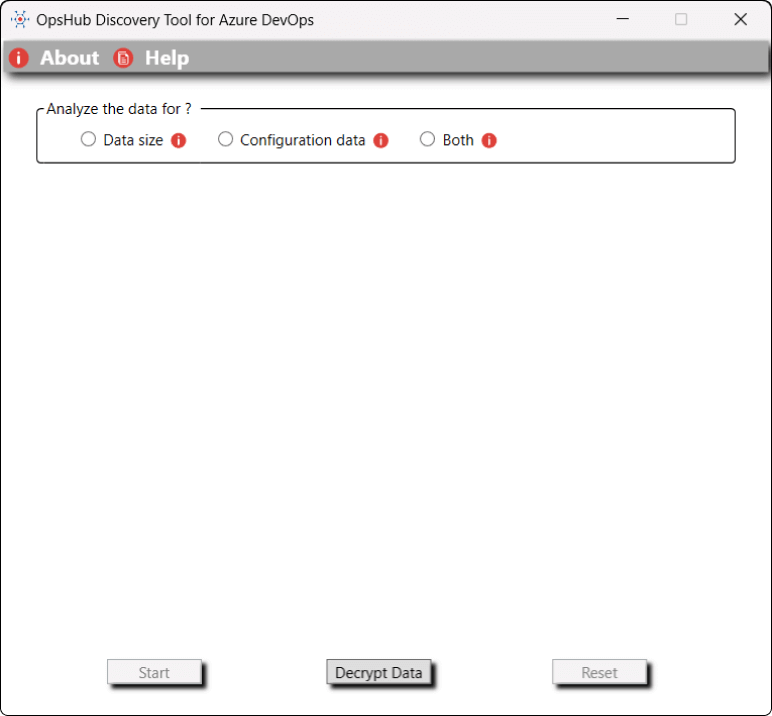
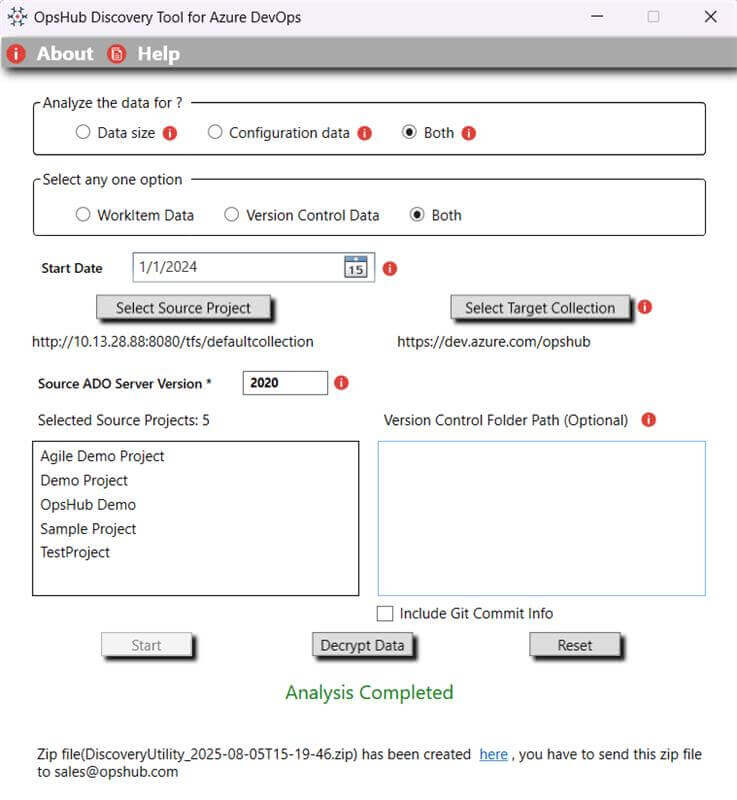
Here you will need to select the purpose behind analyzing the data for:

  1. Data size: This option collects the size related information, i.e., number of users, number of entities, number of revisions, number of changesets, number of labels.
  2. Configuration data: This option collects information that will help in configuring migration/integration such as project template, user details (count and mismatch), and field details.
  3. Both: This option collects information about both Data size and Configuration Data.

Step 4

Select the Start Date
  1. Select the date to count the data updated after this date for work item type entities.
    1. All the revisions of entities updated after selected time is considered.
  2. If no date is selected, all the data will be considered while counting.

Step 5

Select the Option to Gather the Data from the Given Azure DevOps Server/Azure DevOps Services Projects:

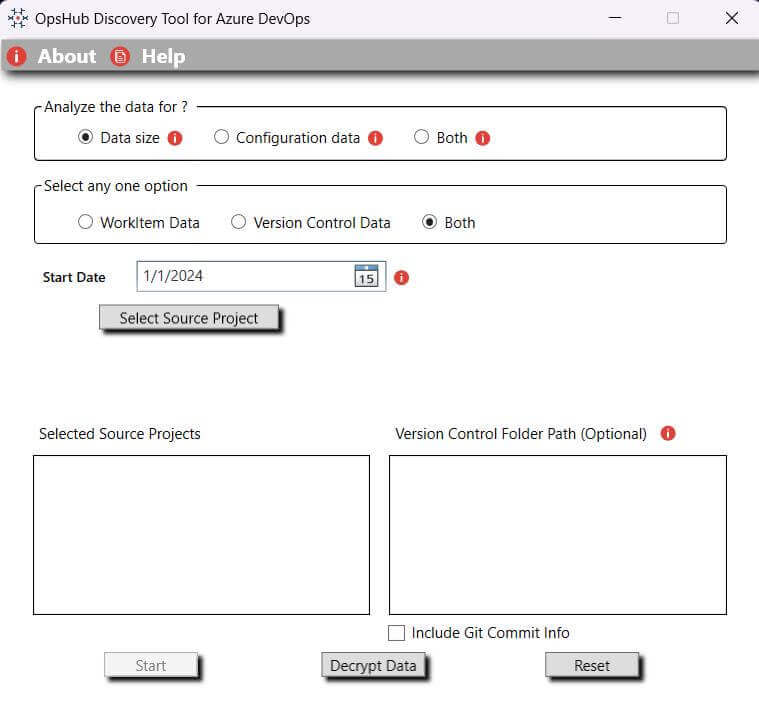
  1. Work Item Data: Gets work item count, revision count and test entities data from the Data size option for the analysis of the provided source projects.
  2. Version Control Data: Gets changeset count and label count for TFVC and size related information (files and folder count) for both Git and TFVC from the Data size option for the analysis of the provided source projects (provided paths).
  3. Both: Gets both Work item and Version Control data. Refer to the screenshot

Note: Tick “Include Git Commit Info” at the bottom right of the screen to include Git commit information in the analysis.

Step 6

Add Source Projects:

  1. Provide the Azure DevOps Server/Azure DevOps Services instance details and project details that need to be taken as source endpoint by clicking Select Source Project
  2. Add the source Azure DevOps Server/Azure DevOps Services instance details and select the projects.

Note: If you select Azure DevOps Server instance, you must specify its version before proceeding with the analysis. Refer to the screenshots below:

Step 7

Add Target Collection [Optional]

  1. Provide Target Collection, only when there is a need to find the template mismatch and the user difference between the source and target projects when analyzing for configuration data.
  2. Provide the Azure DevOps Server/Azure DevOps Services instance details and project collections details that need to be taken as target endpoint by clicking the Select Target Collection button.
  3. Add the target, Azure DevOps Server/Azure DevOps Services details.

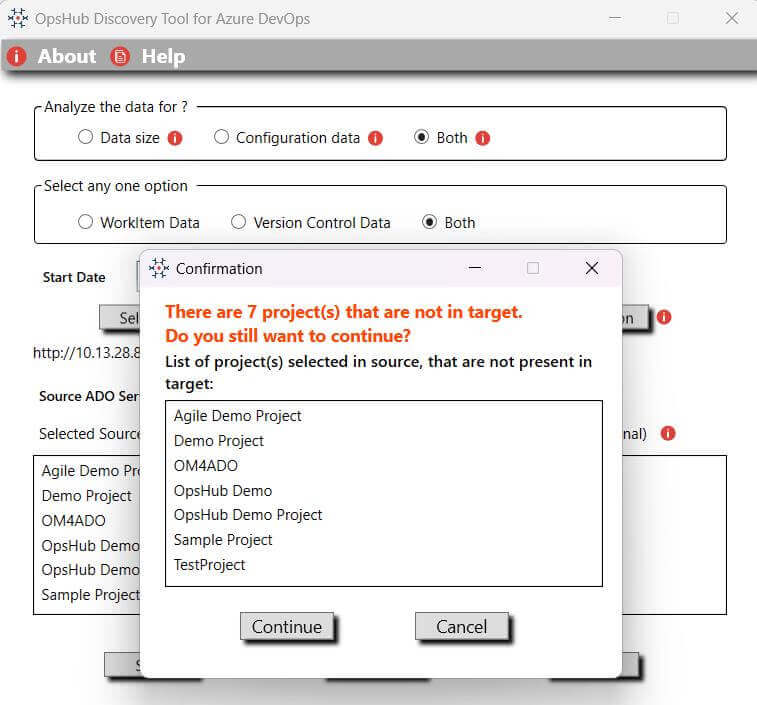
Note: The template mismatch and user difference will be only for common projects (projects with the same name) in source and target. You’ll get confirmation for the same before proceeding with the analysis.

Step 8

Provide Version Control Folder Paths [Optional]

  1. Provide Version Control Folder Paths, only when there is a need to find the Version Control information for specific folders.
  2. Mention the comma separated full paths of the folders for analyzing Version Control.

Note: If the Version Control Folder Path is given, TFVC data for these paths will be analyzed only.

Step 9

Running the Analyzer:
  1. To run the analyzer for the provided projects and provided options, click Start. This will start calculating data based on the provided details of projects and selected options.
  2. Note: Data gathering takes time based on projects you have selected, so please wait until the success message or error message box is displayed. If you want to stop the process, click Cancel
  3. Once the analysis is completed, you will be notified via an output message mentioning that the calculation process is completed. A file will be created and the path containing the information will be displayed as well.
  4. Please find the generated zip file and send that file to sales@opshub.com

Conclusion:

Gathering data with this Utility for Azure DevOps Server/Azure DevOps Services projects will help in estimating the migration duration and provide the details about the complexity of the migration.