TL;DR: For most organisations running regulated, multi-team environments, connecting ALM, DevOps, and ITSM tools through a purpose-built integration platform delivers faster, lower-risk ROI than consolidating onto a single platform, with minimal disruption and near-zero downtime to your teams, workflows, and data throughout the process. Full consolidation carries genuine value in narrowly scoped, single-vendor ecosystems, but the migration cost, retraining burden, workflow disruption, and data-loss risk typically outweigh the licensing savings for any organisation operating across three or more specialised tools.
What does “ROI” actually mean in this decision?
ROI in this context is not just a licensing cost comparison. It spans four categories that every IT leader and program manager needs to weigh before choosing a path.
- Speed to value. How long before teams stop duplicating work and start acting on shared information?
- Total cost of change. What does it cost, in dollars, developer time, and business disruption, to get from the current state to the target state?
- Ongoing operational cost. What does it cost to sustain the solution year after year?
- Risk-adjusted continuity. What happens if the change fails, stalls, or is reversed?
Integration and consolidation score very differently across these four dimensions, and the winning answer depends heavily on how many tools you run, which industries you operate in, and whether your teams can realistically all land on a single platform.
What are the real costs of platform consolidation?
The real costs of platform consolidation fall into four categories that rarely appear in the initial business case: migration effort, retraining and productivity loss, workflow redesign, and long-term vendor lock-in. Consolidation looks attractive on a spreadsheet (fewer licenses, one vendor, simpler procurement), but the hidden costs sit off that spreadsheet.
Migration cost. Moving years of ticket history, test cases, work items, attachments, comments, parent-child relationships, and custom field structures from one platform to another is a substantial project. Data that is not migrated carefully is effectively lost. Organisations in regulated industries such as healthcare, aerospace, defense, finance, and manufacturing often have strict audit trail requirements, meaning that history cannot simply be abandoned. For those considering a consolidation that involves Azure DevOps, note that Microsoft’s Data Migration Tool supports TFS/Azure DevOps Server to Azure DevOps Services migrations natively, while organisation-to-organisation consolidations within Azure DevOps Services require third-party tools such as the OpsHub Azure DevOps Migrator, which handles scenarios including Azure DevOps to Azure DevOps (organisation-to-organisation) and Azure DevOps Server (formerly TFS) to Azure DevOps Services.
Retraining and productivity loss. Support teams built around ServiceNow workflows and development teams built around Jira operate in fundamentally different ways. Consolidating onto one platform means one group abandons the tool their processes were built around. Research summarised by the American Psychological Association (drawing on multitasking studies including Meyer, Evans, and colleagues) indicates that frequent context switching can consume up to 40 percent of a knowledge worker’s productive time, and a new platform forces a temporary but significant productivity dip during adoption.
Workflow redesign. No single platform maps cleanly to every team’s process model. Incident management workflows in ServiceNow and sprint-based development workflows in Azure DevOps use different state models, different field structures, and different automation logic. Forcing one model to serve both teams typically requires extensive custom configuration, which creates its own maintenance debt.
Lock-in risk. Consolidating onto a single platform transfers significant negotiating leverage to that vendor. Multi-year ITSM platform contracts for mid-size deployments can run into hundreds of thousands of dollars annually, with vendor-specific pricing published on request. Any future re-evaluation triggers the same migration cost again.
When consolidation does make sense. If your organisation genuinely operates in a single-vendor ecosystem, for example Jira Software and Jira Service Management in a pure Atlassian shop, consolidation can reduce duplication with manageable change. The ROI case is strongest when the tool overlap is high, team workflows are already similar, and historical data in the outgoing platform is limited or low-value.
What does integration deliver that consolidation cannot?
Integration keeps every team on the tool they already work in, while making data flow automatically between systems. That sounds like a compromise, but in practice it is the higher-performing operating model for most multi-tool environments.
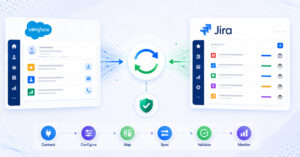
Faster time to value. A well-implemented integration across tools such as ServiceNow, Jira, Azure DevOps, or any of the 70+ platforms OpsHub supports can be live in days or weeks, not the six-to-eighteen-month horizon of a platform migration. Support agents continue resolving incidents in their existing ITSM tool. Developers continue tracking work in their existing ALM or DevOps platform. What changes is that a ticket escalated from support automatically appears as a linked work item in engineering, with all relevant context already attached (priority, customer impact, comments, and attachments), and status updates flow back without manual handoff.
Minimal disruption and near-zero downtime. Neither team needs to learn a new tool, rebuild their workflows, or absorb a productivity drop. In practice, based on typical OpsHub customer deployments, organisations experience minimal disruption and near-zero downtime throughout the integration process. This encompasses not just technical uptime, but continuous business continuity for both the support function and the engineering function, covering teams, data integrity, and business operations. Individual outcomes will vary by environment and scope.
Preserved data context. Effective integration platforms preserve the full richness of each record. This includes comments with @mentions, inline images, attachments, Jira’s three-level hierarchy (epics, stories/tasks, subtasks), parent-child incident chains in ServiceNow, and custom field mappings. Point-to-point connections typically synchronize a limited set of standard fields, leaving context behind and creating gaps that teams fill manually. When a sync runs late or fails, those gaps compound quickly: mentions break in the target system, relationships become orphaned, and teams lose confidence in the data, triggering manual reconciliation that erodes the productivity gain the integration was meant to deliver.
Compliance and audit integrity. In regulated industries, the audit trail is not optional. Integration that preserves field-level history, timestamps, and change provenance is designed to satisfy compliance requirements without the data-loss risk inherent in migration. On-premise and private cloud deployment options mean that sensitive data need not leave the organisation’s own infrastructure, supporting data sovereignty requirements across industries from healthcare and aerospace to finance and manufacturing.
AI and analytics readiness. A connected, context-aware flow of data across your toolchain does more than eliminate manual handoffs. When your ALM, ITSM, and DevOps tools share consistent, enriched data in real time, that data becomes a reliable foundation for AI and analytics initiatives. Feeding a fragmented or incomplete dataset into a Copilot or reporting hub produces fragmented insights. Feeding it a connected, field-level-accurate dataset, with history, relationships, and attachments intact, produces insights teams can actually act on. OpsHub supports this use case directly through its Data Lake for AI and Copilot solution.
Ongoing adaptability. When a team adopts a new tool, replacing one ITSM platform with another, or adding a new DevOps pipeline stage, integration platforms extend to cover that new tool without requiring another full migration. Consolidation, by contrast, means that every new tool addition reopens the consolidation question entirely.
What does integration look like in practice for a regulated manufacturing team?
Consider an organisation in precision manufacturing that runs ServiceNow for IT service management, Jira for software development tracking, and Azure DevOps for build and release pipelines. The support team receives a customer-reported defect that requires a software fix.
Without integration, a support agent manually copies the incident details into a Jira ticket, email the engineering lead, and then periodically checks Jira for updates to paste back into ServiceNow. Each handoff takes time, introduces error risk, and breaks the audit chain.
With OpsHub Integration Manager configured across this toolchain, OIM’s six core strengths come into play from day one.
- Ease of use. Configuration-driven, no-code UI mapping means any administrator can set up and manage field mappings without writing code, reducing dependency on specialist developers.
- Scalability. OIM is built to handle thousands of projects and hundreds of teams as the environment grows, without architectural changes or performance degradation.
- Data richness. Full bidirectional (two-way) synchronization covers history, attachments, relationships, and custom fields, not just standard fields. Comments with @mentions, inline images, parent-child hierarchies, and custom field structures all transfer intact.
- Compliance readiness. Field-level traceability is built in. Every change is timestamped, attributed, and auditable within the tools your teams already use, supporting regulated environments where the audit trail is a non-negotiable requirement.
- Deployment flexibility. OIM can be deployed on-premise, in a private cloud, or as a hosted service, giving organisations full control over where their data lives and how it is accessed. This is particularly relevant for organisations with data sovereignty obligations or internal security policies that restrict cloud-only tooling.
- AI and analytics enablement. Because OIM maintains a connected, context-aware flow of data across your toolchain, your AI and analytics platforms receive a clean, enriched, and consistent dataset. Reporting hubs, Copilot tools, and data lakes all perform better when the underlying data is structurally intact and relationship-aware rather than flattened or fragmented.
The escalation becomes automatic. The moment the support agent flags the incident for engineering, a linked work item is created in Jira with field-level mapping applied: severity maps to priority, incident description maps to story description, and attachments transfer intact. When the engineering team updates the Jira issue, changing status, adding a comment, or closing the item, ServiceNow reflects that change in near real time. The support agent can update the customer without switching tools.
This same model applies across any combination of OpsHub’s 70+ supported tools. Whether your environment runs GitLab alongside Zendesk, Azure DevOps alongside Rally, or any other mix of ALM, ITSM, DevOps, and PLM platforms, OIM’s hub-and-spoke architecture routes data through a single central platform rather than a tangled web of point-to-point scripts. When an additional tool joins the environment, a single platform connection is extended rather than a new bespoke script written, maintained, and tested from scratch.
For global manufacturers and professional services firms operating in regulated industries, including customers in automotive, precision optics, and consulting sectors, this is exactly the operating model that OpsHub’s integration solutions support.
How does this compare to other integration approaches?
Not all integration approaches deliver the same depth of ROI. It is worth mapping the landscape clearly. Minimal disruption and near-zero downtime are only realistic outcomes when the integration architecture supports them from the ground up.
| Approach | Setup cost | Maintenance burden | Data richness | Compliance suitability |
|---|
| Native / built-in connectors | Low | Low | Basic field sync only | Limited |
| CSV or DIY scripts | Medium to high upfront | High ongoing | Configurable but brittle | Variable |
| Purpose-built integration platform (OpsHub Integration Manager) | Medium | Low ongoing | Full: history, attachments, hierarchies, workflow logic | Strong, including on-premise |
| Full platform consolidation | Very high (migration) | Low once complete | Dependent on migration quality | High risk during transition |
Native connectors such as built-in ServiceNow-Jira connections handle basic field synchronization but typically do not carry comment threads, attachment metadata, relationship hierarchies, or workflow state translations. When those elements are missing, teams compensate manually, recreating the context-switching cost that integration was supposed to eliminate. A sync delay of even a few minutes in a multi-directional environment can cause mentions to break, relationships to fall out of sync, and incident states to diverge, compounding the problem across every team involved.
Custom scripts require upfront developer investment to build the sync logic from scratch, then ongoing maintenance whenever either platform updates. A custom script that works on one ServiceNow release may conflict with a later upgrade, and compatibility issues are not always caught in advance. Each new sync direction, entity type, or connector combination requires a separate bespoke script, making the total maintenance overhead compound rapidly. These are automation tools built by developers for specific use cases, not purpose-built migration or synchronization platforms designed for ALM-grade data fidelity.
OpsHub Integration Manager sits in a distinct category. It is built specifically for ALM, ITSM, DevOps, and PLM tool synchronization, with the six core differentiators of ease of use, scalability, data richness, compliance readiness, deployment flexibility, and AI and analytics enablement described above. Its centralized architecture also means that reliability and failure-recovery logic are managed in one place, rather than duplicated imperfectly across a series of separate scripts.
For organisations evaluating a migration solution alongside an ongoing integration strategy, OpsHub offers purpose-built products for both paths, allowing teams to migrate historical data cleanly while keeping live synchronization running throughout.
What does the ROI calculation look like in numbers?
Integration path. A mid-size organisation implementing a managed integration between three tools, ServiceNow, Jira, and Azure DevOps, pays a platform subscription rather than a migration project cost. The productivity gain is near-immediate: manual handoff time eliminated across support and engineering teams, reduced incident resolution time, and fewer errors from context loss. Based on OpsHub customer deployments, integrations across 70+ supported tools can be configured and live within weeks, with positive ROI typically realised within the first quarter of operation.
Consolidation path. The same organisation replacing two tools with one faces a migration project that realistically spans six to eighteen months, requires dedicated project management, involves data mapping and quality work, and absorbs team productivity during cutover and retraining. If the migration fails to carry full data fidelity, the organisation may also face compliance gaps that create additional remediation cost. The consolidation path may not recover its upfront investment for twelve to twenty-four months, and that is before accounting for scope creep or migration rework.
The integration path also eliminates the risk premium associated with consolidation: no failed migrations to recover from, no compliance gaps to explain to auditors, and no team resistance against a tool change they did not want.
Frequently asked questions
Does integrating tools mean giving up the simplicity of a single platform?
No. Integration does not add complexity for end users. Each team member continues working in exactly the same tool and interface they use today. The complexity of routing data between platforms is handled by the integration layer, not by the people using the tools. What changes is that context no longer has to be manually copied: a developer sees the customer-reported severity in their Jira ticket without opening ServiceNow, and a support agent sees the fix status in ServiceNow without chasing the engineering team. The integration is invisible to the user and consequential to the outcome.
What happens when a sync fails or runs late between integrated tools?
With a purpose-built integration platform like OpsHub Integration Manager, sync failures are caught, logged, and retried automatically rather than silently dropping data. The platform provides centralised monitoring and alerting so that issues are surfaced to administrators before they affect team workflows. By contrast, a custom script that fails may do so silently, leaving teams working from divergent data without knowing it. In a multi-directional sync environment, even a single missed update can cascade: a status change that does not propagate means a support agent closes a ticket that engineering has not yet resolved, and an audit trail that shows conflicting states in two systems. A purpose-built platform manages conflict resolution and failure recovery as a core capability, not an afterthought. The Compliance-First Data Integration approach OpsHub takes is designed to maintain data provenance and audit continuity even when individual sync events are retried.
Is integration suitable for organisations that are still choosing their long-term toolset?
Yes. Integration is the lower-commitment path precisely because it does not require you to finalise your tool strategy before capturing value. An organisation that is currently running Jira and ServiceNow but is evaluating a future move to a different ITSM platform can implement integration today, capture the ROI from eliminated manual handoffs immediately, and then migrate the new tool into the integration later without re-doing the work. Consolidation, by contrast, forces a strategic commitment upfront. If the chosen platform turns out not to meet all team requirements, the consolidation cost is sunk and the process begins again.
Is integration or consolidation better for organisations that are still growing their toolset?
Integration is the stronger choice for organisations whose toolset is actively evolving. As teams grow, acquire new capabilities, or adopt specialist tools for security testing, compliance tracking, or customer support, a centralised integration platform extends to cover those new tools without triggering a fresh migration project. OpsHub Integration Manager currently supports 70+ tools across ALM, DevOps, ITSM, and PLM categories, meaning that most tools a growing team might adopt are already covered. Consolidation, by contrast, locks in a single-platform bet at a moment when the organisation’s needs are not yet fully defined. Every tool added outside the chosen platform reopens the integration question anyway, often through native connectors with the field-sync limitations described above. For growing organisations, the integration path scales with the environment rather than constraining it.
How does connected data across tools support AI and analytics initiatives?
AI and analytics tools are only as reliable as the data feeding them. When your ALM, ITSM, and DevOps platforms are siloed, your reporting and Copilot tools receive incomplete, inconsistent snapshots rather than a connected picture of work in progress. OpsHub’s integration architecture maintains field-level accuracy, relationship hierarchies, and full history across your toolchain, so the data flowing into your analytics hub or AI platform reflects what is actually happening across teams. This is the foundation that makes AI-driven insights actionable rather than approximate. OpsHub’s Data Lake for AI and Copilot solution is built specifically to support this use case.
Ready to see what near-zero downtime integration looks like for your specific tool stack? Talk to OpsHub to map out an integration path tailored to your environment.