Supply chains today are expected to do far more than move materials.
They’re being asked to handle constant product changes, regulatory shifts, and engineering decisions — all while staying fast and cost-efficient.
But most of the systems behind them were never designed for digital hybrid teams. They were built to manage excel sheets — not to handle version history, design traceability, or real-time context.
What’s changed?
Traditional supply chain tools weren’t built for this. And workarounds — more calls, more trackers, more portals — only add to the friction.
If your supply chain still operates with spreadsheets and emails, it’s already out of sync with the way your business actually builds products.
Today’s Reality: A Patchwork of Spreadsheets is costing you 100 person hours every week
On the surface, your enterprise tech stack looks complete — PLM handles product data, ERP manages operations, MES tracks manufacturing, and supplier portals close the loop. But when execution requires these systems to work together, the cracks begin to show.
Here’s how the fragmentation plays out:
Systems exist, but coordination doesn’t
Each tool solves a narrow problem — but none of them are built to handle change that flows across the stack. Spec revisions, compliance updates, and deviations get lost in the shuffle.
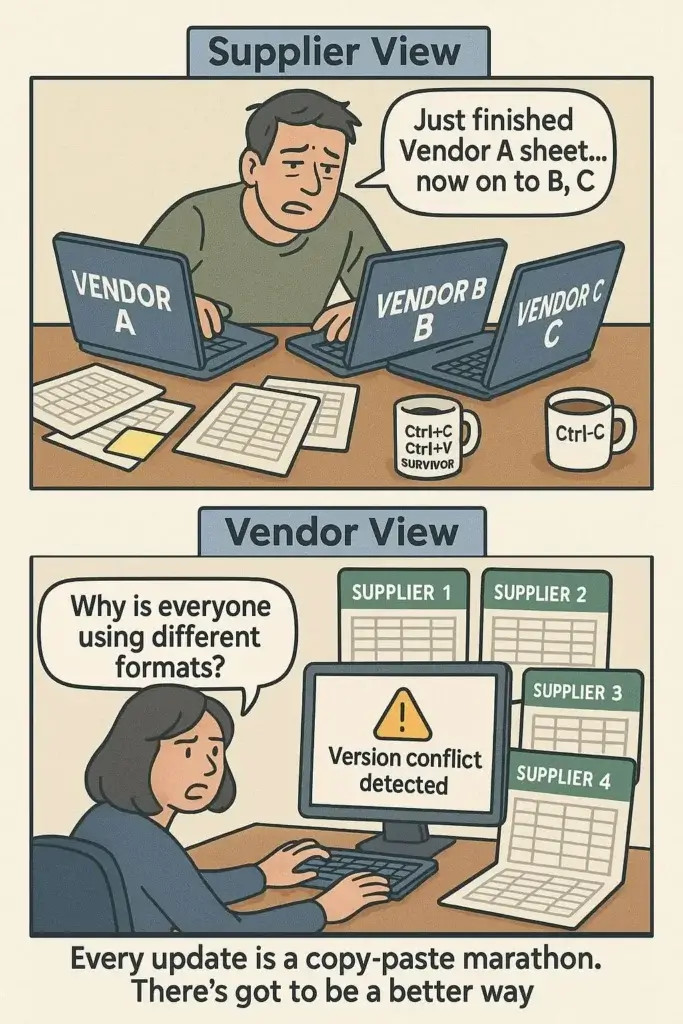
Email and Excel do the heavy lifting
Despite modern tools, day-to-day coordination still depends on spreadsheets, email chains, and status calls — creating delays, duplicate work, and missed handoffs.
Everyone works with a different version of reality
Data in each system follows its own clock. Teams plan and act on outdated or partial snapshots, leading to mismatches and friction downstream.
Problems surface only after it's too late
A supplier manufactures to an old spec. Production starts before engineering updates arrive. A regulatory mandate gets missed because no one mapped the impact across systems.
Digital transformation gets stuck at the pilot phase
AI and automation sound promising — but without reliable, structured, and real-time data underneath, initiatives fail to scale.
What’s Needed: A Data-Driven, Digital Supply Chain Engineering
Supply chains today need to handle constant change without relying on manual coordination, guesswork, or siloed updates. That means rethinking how data flows, how decisions are made, and how risk is caught early.
Here’s what that requires:
Data should meet teams where they work
Engineers shouldn’t have to leave PLM, ERP, or supplier tools to understand what’s happening across the supply chain. The right data with full context should show up in the tools they already use.
Unstructured feedback must be part of decision history
If a supplier’s drawing comment or field observation affects a change request, it should be just as traceable as a spec document. That context should stay linked, not buried in emails.
Change history should be visible without digging
Whether it’s a regulatory update or a design tweak, every impacted part, supplier, or batch should be flagged in real time in the system where each team works.
Traceability should be built-in, not an afterthought
Teams shouldn’t need to piece together context from spreadsheets and folders. Every field, file, and decision should carry its history right where work happens.
This isn’t about new tools, it’s about smarter visibility
To move at today’s pace, supply chains need connected context without tool overload. It’s about making existing systems more intelligent, not replacing them.
The Next Leap: Embedding Intelligence with Copilots and Agentic AI
Once your systems are connected, and data carries full context, the next opportunity is making execution more intelligent.
This doesn’t start with AI — it starts with readiness.
When the foundation is in place, AI can stop being an isolated experiment and start driving real business outcomes.
Here’s what that shift looks like:
AI copilots need structured, lifecycle-aware data to be useful
A copilot is only as smart as the context it can access. If your engineering data, supplier inputs, and change history live in separate silos, it can’t answer even simple questions like “Is this part outdated?” or “Which supplier owns this spec?” To move beyond surface-level assistance, copilots need version-aware, cross-system context.
Intelligent agents should escalate issues, not just alert them
AI can do more than notify. In a connected system, agents can detect when a supplier hasn’t acknowledged a change, flag it, and route it to the right stakeholder — without waiting for a weekly review. This shifts teams from reactive follow-up to proactive coordination.
AI should highlight what’s missing, not just what exists
Most systems tell you what’s stored. Intelligent systems should also point to what hasn’t happened — missing approvals, unassigned tasks, unresolved risks. The value isn’t in surfacing data — it’s in surfacing gaps in execution before they cause problems.
Intelligence must follow business rules and governance
No matter how advanced, AI must respect how your organization works. That means operating within approval workflows, compliance protocols, and system-of-record boundaries. You can’t scale trust if intelligence bypasses control.
With the right foundation, AI isn’t disruptive — it’s directional.
It helps teams move faster, with confidence, and with fewer surprises.
It All Starts with Data: Clean, Connected, and Context-Rich
AI, copilots, and intelligent agents are only as good as the data they rely on.
And in complex supply chains, data quality isn’t just about accuracy — it’s about structure, meaning, and trust.
Here’s what the foundation must include:
AI can’t reason with disconnected, outdated data
Whether it’s a copilot summarizing BOM risks or an agent flagging missed acknowledgments, intelligence fails when the data is fragmented, stale, or out of sync with real-world activity.
Data federation isn’t the same as dumping everything into a lake
True federation means linking systems without breaking ownership or structure. It preserves lineage, respects domain context, and keeps source-of-truth systems intact — while enabling connected insight.
Visibility across systems requires semantic clarity
Pulling data from PLM, ERP, and ALM is not enough. The system needs to understand what that data means, how it connects across domains, and what’s changed — or you’re just recreating silos in a new interface.
Compliance depends on trustworthy data flows
Audit logs are not enough. Regulatory confidence comes from traceable engineering changes, documented decisions, and proof that suppliers received and acknowledged the latest requirements — all grounded in clean data.
Garbage in, hallucination out
No AI system can compensate for poor inputs. For intelligence to be useful, it needs structured, deduplicated, lifecycle-aware data — the kind that reflects the true state of your supply chain at any moment in time.
Data isn’t a backend issue — it’s the make-or-break layer for scalable execution and meaningful intelligence.
The Infrastructure Shift: From Point Integration to Federated Threads
Most enterprises still rely on point-to-point integrations, stitching systems together one connection at a time. Each new tool adds complexity. Every update requires coordination. And visibility depends on who sends what, when.
This approach isn’t just slow. It’s fragile.
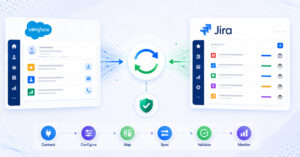
What’s needed now is a federated integration layer that:
- Keeps systems in sync automatically, without manual triggers or approvals
- Delivers instant visibility across teams, not delayed through email chains
- Scales effortlessly new systems or partners can be onboarded in minutes, not months
- Preserves relationships between data, so tools reflect how work actually flows
This isn’t about building more integrations. It’s about upgrading the infrastructure beneath your digital supply chain.
Build for the Questions You Haven’t Asked Yet
It’s not the obvious risks that stall supply chains — it’s the ones no one sees coming.
The missed acknowledgement. The spec change buried in a spreadsheet. The delay that shows up too late to do anything about it.
When systems are fragmented, even the best teams work with partial truths. And in high-stakes environments, partial truths lead to costly decisions.
What separates resilient organizations isn’t just speed — it’s visibility with context.
The ability to trace a change, understand impact instantly, and adapt without friction.
That doesn’t come from more tools.
It comes from infrastructure designed for real-world complexity — where data is connected, decisions are traceable, and nothing gets lost in the cracks.