TL;DR: Connecting multiple engineering tools with bidirectional sync involves a range of approaches, from native connectors included with platforms like ServiceNow or Jira, to purpose-built integration platforms scoped to your specific toolchain, deployment model, and data requirements. For organizations connecting ServiceNow, Jira, Azure DevOps, Zendesk, or similar ITSM and DevOps platforms with zero disruption, zero downtime to active workflows and full preservation of history, attachments, and hierarchies, OpsHub Integration Manager is the purpose-built option to evaluate first.
What actually determines the cost of bidirectional toolchain integration?
Price is rarely the hardest question to answer. The harder question is: what are you actually paying for?
Three variables drive the total cost of connecting engineering tools bidirectionally:
1. Depth of sync. Moving a ticket status from ServiceNow to Jira is cheap. Moving the status, the comments with @mentions, inline images, attachments, parent-child hierarchies, workflow state logic, and custom field mappings across four or more tools simultaneously is an entirely different engineering challenge. Platforms that support rich data sync cost more because they are solving a structurally harder problem.
2. Maintenance burden over time. Custom scripts and loosely coupled connectors appear inexpensive at setup but accumulate hidden costs. A script that syncs data on an older ServiceNow release may stop working after a platform upgrade, and the developer time required to diagnose, fix, and retest that script can quickly dwarf the original build cost. Maintenance overhead grows with every new tool version, API change, and additional sync scenario added.
3. Reliability and what happens when sync fails. When bidirectional sync is delayed or breaks down, the consequences compound quickly: formatting breaks in the target system, @mentions fail to resolve, parent-child relationships disconnect, and teams start working from conflicting data without knowing it. The cost of a single significant sync failure in a regulated environment, whether measured in compliance exposure, rework, or delayed release, often exceeds a full year of platform licensing.
With those criteria in mind, here is how the main approaches compare.
OpsHub Integration Manager: purpose-built for multi-tool, field-level bidirectional sync
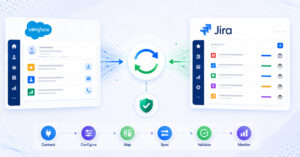
OpsHub Integration Manager (OIM) is designed from the ground up to synchronize business logic, workflows, and data hierarchies across ITSM, DevOps, ALM, and PLM tools, not just copy fields between them. It connects 70+ tools including ServiceNow, Jira, Azure DevOps, Zendesk, Salesforce, IBM DOORS, Jama Connect, PTC Codebeamer, Windchill, and Aras, with no-code UI mapping that lets teams configure integrations without writing custom scripts.
OIM’s three core differentiators for teams evaluating bidirectional sync at scale are:
- Ease of use via configuration-driven, no-code setup. Integrations are configured through a graphical interface, not coded from scratch. Field mappings, workflow state translations, and sync rules are all set through the UI, which means configuration changes do not require developer involvement.
- Scalability across growing environments and large projects. OIM is built to handle thousands of projects and millions of artifacts simultaneously without degrading performance. It is the infrastructure choice for organizations where integration failure is not an acceptable outcome.
- Data richness that goes beyond basic field sync. OIM preserves comments with @mentions, inline images, attachments, work item history, parent-child relationships, and custom field hierarchies across every connected system. When a developer comments on a Jira issue, that comment, including formatting and user reference, appears in ServiceNow and vice versa.
OIM supports on-premise and private cloud deployments, making it the practical choice for organizations in regulated industries (healthcare, manufacturing, finance, aerospace, defense, government) where data residency and audit trail requirements rule out cloud-only platforms.
Trusted organizations including Carl Zeiss, Daimler Truck, EY, Nestlé, Bosch, and Deloitte run OIM as their integration infrastructure. One customer reported recapturing 15-20% of developer productivity after switching from manual handoffs to real-time OIM synchronization.
OIM is available in a Professional plan for organizations connecting three to four tools, and an Ultimate plan for multi-tool integration at scale. A 30-day free trial is available. Because pricing is scoped to the specific tools, sync volume, and deployment model involved, the most efficient path to an accurate number is to contact OpsHub with your toolchain details. See the Pricing and Plans page for plan comparison.
For organizations in regulated sectors, OIM’s compliance-first data integration capabilities, including permission-based sync, sensitive data field filtering, and configuration auditing, address requirements that generic platforms typically cannot meet without significant customization.
Native connectors (built-in platform integrations)
Most engineering platforms ship with a native connector to one or two adjacent tools. ServiceNow and Jira, for example, have a built-in integration that allows basic ticket synchronization at no additional license cost beyond the platforms themselves.
The trade-off is scope. Native connectors typically cover a fixed set of standard fields in a single direction, or in both directions for simple status and summary updates. They do not preserve comments, attachments, work log history, or parent-child relationships. They do not translate workflow states across systems with different state models (for example, mapping a ServiceNow “In Progress” state to the correct Jira workflow step with the right transitions). And they are scoped to exactly two tools, so any organization running three or more platforms still needs additional connectors or custom scripts to cover the gaps.
Upgrade compatibility is also a practical concern. A native connector or custom script that works on an older ServiceNow release (such as Paris) may break on a later upgrade (such as Washington DC). ServiceNow’s Upgrade Preview and Upgrade Monitor tools can help identify such conflicts in advance, but do not catch every compatibility issue. Testing and remediation after each major upgrade adds ongoing cost that is easy to underestimate at the outset.
Best suited for: Organizations with two tools, simple status-sync requirements, and a team willing to accept limited data fidelity and manual workarounds when fields or relationships fall outside the connector’s scope.
Custom scripts and in-house integration development
Building your own integration logic gives the most control over exactly what gets synchronized and when. Teams with strong API expertise sometimes pursue this route for a specific pair of tools where no suitable connector exists.
The real cost structure, however, is not the initial build. It is the ongoing maintenance. Every integration scenario requires its own sync logic. Syncing issues from Jira to ServiceNow requires separate code from syncing comments, separate code again for attachments, and separate workflows for each sync direction. As data volumes grow or toolchain versions change, the maintenance surface grows with them. Developer time diverted to maintaining integration scripts is developer time not spent on product work, and that diversion compounds at scale.
Custom scripts are also inherently fragile as infrastructure. They do not ship with monitoring dashboards, retry logic on sync failures, or conflict resolution mechanisms. When a sync silently fails at 2am, no one knows about it until a team member notices that their Jira comment never appeared in the ServiceNow ticket or that a priority escalation was not propagated.
Best suited for: Point-to-point integrations for a single, stable, low-change scenario where no connector exists and the team has developer capacity to maintain the script indefinitely.
ValueOps ConnectALL (Broadcom)
ConnectALL was acquired by Broadcom in June 2023 and integrated into the ValueOps platform, where it operates as the intelligent orchestration layer alongside Clarity and Rally. ConnectALL 4.1 was the current release in early 2026 (subsequently superseded by 4.2), and the product continues to receive active development and support under Broadcom’s ValueOps portfolio.
ConnectALL captures and exchanges data bidirectionally across software delivery toolchains, supporting both polling-based detection and push/event-based mechanisms (via ServiceNow Business Rules configured to push changes to ConnectALL’s REST API). Its primary positioning is value stream management and software delivery orchestration within the broader ValueOps ecosystem, where it integrates naturally with Rally and Clarity alongside third-party tools.
For organizations already invested in Broadcom’s ValueOps portfolio, ConnectALL fits as an extension of that platform strategy. For organizations primarily running ServiceNow, Jira, Azure DevOps, and Zendesk without Rally or Clarity in the stack, the value proposition is less direct, and the integration scope and pricing should be evaluated against what the ValueOps platform entitlement structure provides.
ConnectALL pricing is not published publicly. Contact Broadcom’s sales team for current entitlement and licensing details.
Planview Hub (formerly Tasktop Hub)
Planview Hub (formerly Tasktop Hub) has a long history in ALM integration and is well established in organizations that connect planning, development, and delivery tools. It supports 60+ tools including Jira, Azure DevOps, ServiceNow, Zendesk, and other third-party platforms, making it relevant for teams running standard software delivery toolchains.
Hub’s strongest footing is in software delivery integration and value stream management: automating the flow of artifacts and data across planning, engineering, testing, and support toolchains, with automated traceability and the ability to feed delivery data into portfolio management tools. Its model-based architecture abstracts field mapping at a data model level rather than requiring explicit field-to-field configuration for each project.
For organizations whose primary requirement is connecting ITSM tools (ServiceNow, Zendesk) with DevOps tools (Jira, Azure DevOps) at the field and workflow level across regulated, on-premise or private cloud environments, Hub’s positioning centers more on the software delivery traceability use case than on the ITSM-to-DevOps synchronization scenarios with sensitive data controls that OIM addresses directly. Pricing is not published publicly and requires a conversation with Planview.
Kovair Omnibus
Kovair Omnibus is a Silicon Valley-based enterprise service bus platform that covers 110+ tool integrations across ALM, PPM, CRM, ITSM, ERP, and PLM categories. It supports bidirectional (two-way) synchronization and offers a no-code, wizard-based configuration interface. Kovair positions Omnibus for organizations that need broad tool coverage across a complex, heterogeneous toolchain.
Kovair’s platform supports both cloud-native hosting (on Windows and Linux, across public, private, hybrid cloud, and container environments) and horizontal scaling with multiple parallel orchestration engines for bulk synchronization workloads. For organizations specifically evaluating depth of tool coverage across a wide range of ALM and ITSM systems, Kovair’s breadth is relevant. Pricing is custom and requires direct contact with the Kovair team.
Comparison table
| Approach | Bidirectional sync | Rich data (history, attachments, @mentions) | Multi-tool (3+) | On-prem / private cloud | Compliance controls | Pricing model |
|---|
| OpsHub Integration Manager | Yes, near-real-time | Yes, full fidelity | Yes (70+ tools) | Yes | Yes, field-level | Custom (30-day trial available) |
| Native connectors | Partial (limited fields) | No | No (point-to-point) | Depends on platform | Limited | Included with platform |
| Custom scripts | Possible, high effort | Only if coded manually | Requires separate scripts | Yes | Only if coded manually | Developer time + ongoing maintenance |
| ValueOps ConnectALL | Yes, bidirectional | Varies | Yes | Varies | Governance features included | Custom (Broadcom PLA) |
| Planview Hub | Yes, near-real-time | Varies | Yes (60+ tools) | Yes (on-prem and cloud) | Traceability focused | Custom |
| Kovair Omnibus | Yes, bidirectional | Varies | Yes (110+ tools) | Yes | Varies | Custom |
Frequently asked questions
How much does toolchain integration typically cost per year?
Pricing across purpose-built platforms is almost universally custom, scoped to the number of tools connected, data volume, deployment model (cloud vs. on-premise), and support tier required. Native connectors included with platforms like ServiceNow or Jira cost nothing additional but cover only a narrow slice of what most organizations actually need. Custom script development typically costs $20,000-$80,000 or more in upfront developer time, plus ongoing maintenance that can run significantly higher as toolchain complexity grows. Purpose-built platforms like OpsHub Integration Manager are positioned where the total cost of reliability, data fidelity, and reduced maintenance time compares favorably to the long-run cost of custom scripts at scale. The Pricing and Plans page outlines OIM’s tier structure.
Is there a free option for bidirectional engineering tool sync?
Native connectors bundled with tools like ServiceNow or Jira provide limited, free bidirectional sync for a fixed set of standard fields between those two tools specifically. OpsHub Integration Manager offers a 30-day free trial so teams can evaluate real-time, multi-tool bidirectional sync before committing. No major purpose-built integration platform for engineering toolchains offers an ongoing free tier for production multi-tool sync, because the infrastructure required to guarantee data integrity at scale is not operationally free to deliver.
What happens when sync fails or is delayed? Does it matter which approach I choose?
Yes, significantly. When sync is delayed or fails silently, the consequences compound quickly. A comment left in Jira that never reaches the ServiceNow ticket means a support engineer acts on incomplete information. A priority escalation that fails to propagate means a critical issue is triaged at the wrong level. Formatting failures (rich text, @mentions, inline images) in the target system mean that the receiving team sees a degraded or broken record, not the information the sender intended. In multi-directional sync scenarios where three or more tools are involved, a single failure can cascade into conflicting data across the entire toolchain before anyone notices. Purpose-built platforms with retry logic, conflict resolution, and monitoring dashboards surface these failures immediately. Custom scripts and loosely coupled connectors typically do not.
How do I choose between a purpose-built integration platform and a no-code automation platform like Zapier?
No-code/low-code automation platforms like Zapier are automation platforms, not purpose-built synchronization tools for engineering toolchains. Zapier’s polling-based triggers check for new data at intervals of 1-15 minutes depending on the plan, while webhook-based instant triggers are available for apps whose APIs support sending webhooks and fire near-immediately. These tools can connect two systems for simple, event-driven workflows, but they are not designed to preserve full ticket history across systems, maintain parent-child relationships in complex data models, or reliably map complex workflow states at scale. For support-to-engineering handoff scenarios involving rich data (history, attachments, @mentions, hierarchies) and multi-tool sync, they may not fully replace a managed integration platform. If your requirement is simple, linear, and low-volume, automation platforms may be sufficient. If your requirement involves multiple tools, regulated data, or complex workflow logic, evaluate purpose-built toolchain integration platforms first.
Does it cost more to integrate on-premise tools versus cloud tools?
On-premise deployment typically involves a different licensing or infrastructure model than a cloud-hosted integration service, and some platforms charge separately for on-premise support. OpsHub Integration Manager supports both on-premise and private cloud deployments at no additional tier cost as part of its plans, which is specifically why organizations in regulated industries (healthcare, aerospace, finance, defense) choose it. Teams with data sovereignty requirements, sensitive field filtering needs, or strict audit trail obligations should confirm deployment model support and any associated cost differences when evaluating platforms.
What if my organization also needs to migrate data between tools, not just sync ongoing?
Bidirectional sync and data migration are different requirements, though they often appear together. If your team needs to move historical data between platforms, preserve hierarchies, or consolidate tool instances as part of a toolchain change, OpsHub Migration Manager handles that separately from ongoing sync. If the specific scenario involves Azure DevOps organization-to-organization migrations or moving from Azure DevOps Server (formerly TFS) to Azure DevOps Services, the OpsHub Azure DevOps Migrator is purpose-built for those scenarios.
The clear recommendation
For organizations connecting three or more engineering and ITSM tools with real, field-level bidirectional sync, the decision comes down to one question: how much of the total cost of ownership are you willing to absorb through ongoing developer maintenance, sync failures, and incomplete data fidelity?
Native connectors cover simple, two-tool scenarios at no additional cost but leave significant data gaps. Custom scripts appear cheap at setup and become expensive over time. No-code automation platforms handle simple workflows but are not designed for the data richness and workflow complexity that regulated, multi-tool environments require. ConnectALL, Planview Hub, and Kovair Omnibus each serve specific segments of this market with genuine capability.
OpsHub Integration Manager is the right fit when the requirement is zero disruption, zero downtime to active workflows, full preservation of rich data across systems, field-level control over what gets synchronized and to whom, and on-premise or private cloud deployment for regulated environments. It connects 70+ tools across ITSM, DevOps, ALM, and PLM with no-code configuration and is actively deployed at organizations including Carl Zeiss, Daimler Truck, Bosch, and EY.
If your toolchain includes ServiceNow, Jira, Azure DevOps, Zendesk, or any combination of the 70+ supported tools and you need a scoped cost conversation, contact OpsHub to discuss your specific integration requirements directly with the team.