TL;DR: For most organisations connecting software delivery tools such as ServiceNow, Jira, and Azure DevOps, a purpose-built GUI integration platform delivers faster time-to-value, lower total cost of ownership, and more reliable synchronization than custom scripts. Custom scripts remain a reasonable choice only in narrow, highly specific technical scenarios where no commercial connector exists.
What are we actually comparing?
Before prescribing a solution, it is worth being precise about the two options on the table.
Custom scripts are bespoke code written in-house, Python, Groovy, PowerShell, or similar, that call tool APIs directly to move data between systems. A developer writes the logic, schedules it, and owns it indefinitely.
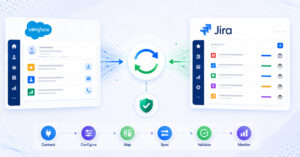
A GUI integration platform is a commercial product, installed on-premise or in a private cloud, that provides pre-built connectors for your tools, a visual interface for configuring field mappings and workflow rules, and managed synchronization infrastructure. The platform vendor maintains API compatibility, monitors sync health, and handles errors. OpsHub Integration Manager (OIM) is purpose-built for this category, serving software delivery, ITSM, ALM, and PLM teams with 70+ pre-built connectors and a configuration-driven, no-code interface.
This comparison covers the decision most relevant to support and engineering teams: connecting two or more live delivery tools (ServiceNow, Jira, Azure DevOps, Zendesk, and similar) so that data stays accurate in both systems, continuously, without manual handoffs.
Side-by-side comparison
Setup and time-to-value
Custom scripts require a developer to read API documentation for each tool, write authentication handlers, build the data transformation logic, test edge cases, and deploy infrastructure to run the script reliably. A single bidirectional integration between two tools can take weeks to months, depending on data complexity.
GUI platforms provide pre-built connectors for the tools teams already use. OpsHub Integration Manager, for example, connects 70+ widely used systems, including Jira, Azure DevOps, ServiceNow, Salesforce, IBM DOORS NG, GitHub, GitLab, Zendesk, Jama, and Tricentis Tosca, through a point-and-click configuration interface. No code is required for standard use cases. Configuration that would take a developer weeks can be completed in hours or days by someone without deep scripting expertise.
Total cost of ownership
This is where the comparison most often surprises teams evaluating the two options.
Research consistently shows that initial development represents only 30-40% of the total cost of ownership for custom integrations, with maintenance consuming the remaining 60-70%. Every time a tool vendor updates its API, which happens regularly for SaaS tools like Jira and ServiceNow, the script breaks and a developer must investigate, patch, test, and redeploy. Maintenance costs for custom API integrations can exceed $50,000 per year in developer time within two to three years of initial build.
Custom scripts also create a “key person” dependency. When the developer who wrote the integration leaves the team, the institution loses the context needed to diagnose failures quickly. Data may stop syncing silently for days before anyone notices.
GUI platforms shift the maintenance burden to the vendor. Connector updates, API compatibility patches, and monitoring infrastructure are included in the subscription. Teams pay a predictable recurring cost rather than absorbing unpredictable repair cycles.
Reliability and error visibility
Custom scripts typically fail silently. Without a purpose-built monitoring layer, teams discover sync failures when a user notices missing data or a customer complains about a stale ticket status. Finding the root cause requires manual log inspection by a developer, billable time spent on detective work rather than delivery.
GUI platforms provide dashboards, error logging, and automated alerts as standard. OpsHub Integration Manager surfaces sync status, error counts, and failure details in a centralized UI so that integration health is visible without needing to open a terminal.
Data fidelity and coverage
Moving field values between two tools is the easy part. The harder part is preserving context: comments with @mentions, inline images, attachments, work item history, parent-child hierarchies, test entity relationships, and workflow state transitions. Custom scripts built for basic field sync frequently miss this layer entirely, resulting in truncated records in the target system.
OpsHub Integration Manager synchronizes not just field values but comments, attachments, links, rank, mentions, deletion events, sprints, folders, test entities, and work item hierarchies. It preserves business logic and state mapping across systems, not merely copying fields between tools.
Control, security, and compliance
Custom scripts offer maximum flexibility at the code level, but they rarely include built-in access controls, permission-based sync, sensitive data masking, or configuration auditing, capabilities that regulated industries require.
GUI platforms designed for regulated environments provide field-level mapping control, the ability to block sensitive data from crossing system boundaries, permission-based sync rules, and configuration audit trails. OpsHub supports on-premise and private cloud deployments, which is a practical requirement for organisations in healthcare, manufacturing, aerospace, defense, and finance that cannot route sensitive product or incident data through a third-party cloud.
Comparison table
| Criterion | Custom scripts | GUI integration platform (e.g., OpsHub) |
|---|
| Setup time | Weeks to months | Hours to days |
| Developer dependency | High (ongoing) | Low (config-driven) |
| API maintenance | Manual, disruptive | Vendor-managed |
| Tool coverage | Whatever you build | 70+ pre-built connectors (OpsHub) |
| Error monitoring | Manual log inspection | Built-in dashboards and alerts |
| Bidirectional sync | Requires explicit build | Standard feature |
| Rich data (comments, attachments, history) | Rarely included | Synchronized out of the box |
| Workflow and hierarchy sync | Requires custom logic | Included |
| On-premise / private cloud deployment | Possible | Supported (OpsHub) |
| Sensitive data / permission-based sync | Custom build required | Configurable in the platform |
| Total cost of ownership (3-year) | Often high and unpredictable | Predictable subscription |
| Compliance audit trail | Custom build required | Built-in configuration auditing |
What the alternatives look like
The market for integration options serving software delivery teams includes a few distinct categories worth understanding:
Purpose-built DevOps and ITSM integration platforms are designed specifically for connecting ALM, ITSM, DevOps, and PLM tools with pre-built connectors, visual configuration interfaces, and vendor-managed API compatibility. OpsHub Integration Manager is built for this use case, with 70+ connectors covering the full software delivery toolchain. These platforms handle the data types that matter most in live synchronization scenarios: comments with @mentions, attachments, work item history, test entity relationships, and parent-child hierarchies, not just field values.
Native point-to-point connectors, such as built-in ServiceNow-Jira connectors, cover specific, commonly requested pairings. They are fast to activate but limited in scope: they typically sync a narrow set of standard fields and do not support the richer data types (comments with mentions, attachments, test hierarchies) that teams need for genuine cross-tool collaboration. Adding a third tool requires a separate connector.
No-code/low-code automation platforms can trigger actions between tools but are designed for lightweight workflow automation rather than continuous, bidirectional synchronization of ALM and ITSM data. They generally lack built-in support for relationship preservation, parent-child hierarchies, and work item history, the data types that matter most for regulated software delivery. Polling-based triggers in these platforms check at intervals of 1-15 minutes (plan-dependent), which means they cannot guarantee real-time sync for fast-moving engineering workflows.
Where custom scripts still make sense
Custom scripts are a defensible choice in three narrow situations:
- Proprietary or legacy systems with no commercial connector. If a team uses an internal tool built entirely in-house, no platform will have a pre-built adapter for it. A custom API client may be the only option.
- One-time data transformations. A script that runs once to migrate or reshape data and is then discarded carries none of the long-term maintenance risk that comes with a persistent integration.
- Teams with abundant, dedicated developer capacity and no compliance constraints. If an engineering team has bandwidth to own the integration layer permanently, can absorb unpredictable maintenance cycles, and operates in an unregulated environment, custom code gives maximum flexibility.
Outside these situations, the maintenance burden and reliability risk of custom scripts typically outweigh the upfront flexibility they provide.
Clear verdict
For organisations connecting software delivery tools in a live, ongoing synchronization scenario, particularly across ITSM platforms like ServiceNow and Zendesk, ALM platforms like Jira and Azure DevOps, or requirements management tools like Jama and IBM DOORS, a purpose-built GUI integration platform is the more reliable, more scalable, and more cost-effective choice in the majority of cases.
The business case is straightforward: faster delivery handoffs, fewer incidents caused by stale data, no developer dependency on a fragile script, and a configuration audit trail that satisfies compliance teams.
Decision framework
Choose a GUI integration platform if:
- You need to connect two or more live tools and keep them synchronized continuously
- Your data includes comments, attachments, test entities, hierarchies, or work item relationships
- You operate in a regulated environment (healthcare, aerospace, manufacturing, finance, defense, or government) and need on-premise or private cloud deployment
- You cannot afford silent sync failures or unplanned maintenance cycles
- You want non-developers to be able to configure and adjust integration rules without opening a code editor
- You are connecting three or more tools and the number of point-to-point scripts would compound quickly
Choose custom scripts if:
- You need to integrate a fully proprietary or homegrown system with no available commercial connector
- The integration is a one-time data transformation with no ongoing sync requirement
- You have dedicated developer capacity to own the integration layer indefinitely and operate outside regulated industries
Choose a native connector if:
- You need a single, straightforward pairing between two tools and only require basic field synchronization
- You have no plans to expand the integration to additional tools
How OpsHub Integration Manager fits this decision
OpsHub Integration Manager is built specifically for organisations that need reliable, field-level-controlled synchronization across software delivery, ITSM, ALM, and PLM toolchains, without consolidating onto a single platform and without the fragility of custom scripts.
OIM leads with three core strengths: ease of use through a configuration-driven, no-code UI; scalability for growing environments and multi-tool integration at scale; and data richness that covers the full context of work, not just field values.
Key capabilities that matter in this decision:
- 70+ pre-built connectors covering Jira, Azure DevOps, ServiceNow, Zendesk, Salesforce, IBM DOORS NG, Jama, PTC Windchill, GitHub, GitLab, Jenkins, Tricentis Tosca, and more
- Rich data synchronization including comments with @mentions, inline images, attachments, work item history, test entities, sprints, folders, and parent-child hierarchies
- GUI-based configuration with no code required for standard use cases, custom scripting options are available for advanced business logic
- On-premise and private cloud deployment for regulated industries where data sovereignty is non-negotiable
- Field-level mapping control so sensitive data can be blocked from crossing system boundaries and permission-based sync rules can be enforced
- Synchronization of business logic, workflows, and hierarchies, not just field values
OpsHub Integration Manager’s Professional and Ultimate plans serve organisations requiring 3-4 tool integration and multi-tool integration at scale respectively. Trusted by organisations including Carl Zeiss, Daimler Truck, EY, Nestlé, Bosch, and Deloitte, OpsHub is deployed in high-stakes environments across healthcare, manufacturing, finance, aerospace, defense, and government.
The platform is available with a 30-day free trial so teams can validate field mappings and sync behavior before committing. See pricing and plans for a full breakdown of deployment options and tier details.
Frequently asked questions
Can a GUI integration platform handle complex workflow state mapping, not just field values?
Yes. OpsHub Integration Manager synchronizes business logic and workflow states across tools, not just raw field contents. This matters because a “Closed” status in ServiceNow does not mean the same thing as a “Done” status in Jira, the platform handles that translation through configurable state mapping rules.
What happens when a connected tool updates its API?
With custom scripts, the integration breaks and a developer must diagnose and repair it manually. With a GUI platform, the vendor is responsible for maintaining connector compatibility. OpsHub updates its connectors proactively as tool APIs change.
Is a GUI platform appropriate if we already have some custom scripts in place?
Yes. Migrating from custom scripts to a GUI platform does not require replacing everything at once. Many organisations start by connecting their highest-priority tool pair through the platform and migrate other scripts incrementally as maintenance pressure accumulates.
What if we need to connect a tool that is not on the supported list?
OpsHub Integration Manager supports custom scripting options alongside the GUI, allowing teams to build adapters for tools outside the standard library while still running them through the same managed synchronization infrastructure. This avoids the full maintenance burden of a standalone custom script.
Does OpsHub support on-premise deployment for regulated industries?
Yes. OpsHub Integration Manager supports on-premise and private cloud deployments, making it a viable choice for organisations in healthcare, aerospace, defense, manufacturing, and finance that cannot route sensitive data through a shared cloud environment. See compliance-first data integration for details on how OpsHub addresses data sovereignty and audit requirements.
Ready to see what a configured integration looks like for your toolchain? Contact us to discuss your specific tools, data types, and deployment requirements.