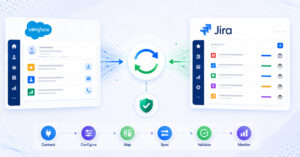
Salesforce captures customer-facing activities while Jira manages engineering execution. Integrating the systems reduces manual handoffs and improves transparency across teams. This guide covers architectural considerations, mapping strategies, and integration best practices.
Sync Tool Evaluation FrameworkRate importance & vendor support - section
dropdowns apply to all items
📋
How to Use This Checklist
Each category header has section-level dropdowns to bulk-apply importance and
support ratings across all items in that section at once. Fine-tune individual items below the
header as needed. Scores = Importance weight × Support weight. The last section flags anti-patterns
— each “Yes” there deducts 1 point.
Non-negotiable = 1.0×
Good to have = 0.5×
Not needed = 0×
Yes, out-of-box = 2 pts
Yes, with scripting = 1 pt
Partial info = 0.5 pts
Not supported = 0 pts
Red flag present = −1 pt
CAT 1
🔄
Sync data fidelity
10/10 answered20.0 / 20.0
▼
Apply to all items in this section:Fine-tune individual items below
SYNC DATA FIDELITY · 1
Bi-directional sync with full field mapping
Changes flow in both directions seamlessly. All field types , text,
dropdowns, dates, numbers, and custom fields , are mapped accurately without data loss.
Score: 2.00
SYNC DATA FIDELITY · 2
Relationship and dependency preservation
Cross-item links such as 'blocks', 'relates to', 'is child of', and
'depends on' are recreated as equivalent relationships in the target system.
Score: 2.00
SYNC DATA FIDELITY · 3
Comments and attachments sync
Discussion threads and file attachments transfer with original author
attribution, timestamps, and file content intact.
Score: 2.00
SYNC DATA FIDELITY · 4
Hierarchical folder / module preservation
Parent-child structures, folder trees, and module groupings are
reproduced faithfully , items are never flattened into a single unorganised list.
Score: 2.00
SYNC DATA FIDELITY · 5
Historical data sync
Sync can start from a specific past date, bringing existing records
and their change history across , not just future activity.
Score: 2.00
SYNC DATA FIDELITY · 6
@Mentions sync in rich text and comments
User mentions inside comment bodies or rich-text fields are
recognised and mapped to the correct matching user in the target system.
Score: 2.00
SYNC DATA FIDELITY · 7
Formatting and inline images retention
Text formatting (bold, lists, tables, code blocks) and inline images
survive the sync , they are not stripped down to plain text.
Score: 2.00
SYNC DATA FIDELITY · 8
Deleted work items sync
When an item is deleted in the source, the counterpart on the other
side is removed or marked deleted , ghost records do not accumulate.
Score: 2.00
SYNC DATA FIDELITY · 9
Duplicate removal on move or type change
Moving a work item across projects or changing its type does not
create a duplicate on the other side. The tool recognises it as the same record.
Score: 2.00
SYNC DATA FIDELITY · 10
Automated user mapping by email address
Users are matched between systems automatically using their email
address, eliminating the need for a hand-crafted mapping table.
Score: 2.00
CAT 2
⚡
Sync reliability
0/4 answered--
▼
Apply to all items in this section:Fine-tune individual items below
SYNC RELIABILITY · 1
API throttling and exponential back-off
When a system returns a rate-limit error (HTTP 429), the tool pauses,
waits progressively longer between retries, and resumes , no items are dropped.
SYNC RELIABILITY · 2
Resilience to abrupt in-flight sync failures
If the connection drops or a system goes offline mid-sync, the tool
picks up exactly where it left off , no items are skipped, duplicated, or silently lost.
SYNC RELIABILITY · 3
Incremental sync
Only records that actually changed since the last sync run are
processed, keeping cycles fast and API usage low even on very large projects.
SYNC RELIABILITY · 4
Conflict detection and resolution
When the same field is edited on both sides before a sync, the tool
detects the conflict and applies a configurable rule: source-wins, timestamp-wins, or
manual review queue.
CAT 3
🛠
Ease of setup and maintenance
0/6 answered--
▼
Apply to all items in this section:Fine-tune individual items below
EASE OF SETUP AND MAINTENANCE · 1
Out-of-the-box connector library
Pre-built connectors for popular tools (Jira, Azure DevOps,
Codebeamer, GitHub, GitLab, ServiceNow, etc.) work out of the box without writing any
code.
EASE OF SETUP AND MAINTENANCE · 2
Self-service GUI configuration
Any authorised team member , not just developers , can set up,
adjust, and manage integrations entirely through a point-and-click interface.
EASE OF SETUP AND MAINTENANCE · 3
Automated API-driven integration creation
New integrations can be created by sending a structured API request,
enabling teams to spin up or clone integrations programmatically as part of a CI/CD
pipeline.
EASE OF SETUP AND MAINTENANCE · 4
AI-assisted mapping and documentation
Built-in AI or LLM-powered suggestions help auto-generate field
mappings and connector documentation, cutting setup effort significantly.
EASE OF SETUP AND MAINTENANCE · 5
Data transformation (format and timezone)
Rich text is converted between HTML, Wiki, and Markdown automatically
as each system requires. Date and time values are adjusted for timezone differences
without any manual work.
EASE OF SETUP AND MAINTENANCE · 6
Real-time monitoring dashboard
A live dashboard shows sync status, throughput, error rates, and
activity , filterable by connector, project, or system instance , so issues are spotted
immediately.
CAT 4
🔌
Extensibility and customization
0/6 answered--
▼
Apply to all items in this section:Fine-tune individual items below
EXTENSIBILITY AND CUSTOMIZATION · 1
API redirection (split read/write nodes)
Read and write traffic can be directed to separate API endpoints
within the same integration, supporting enterprise architectures that split read/write
infrastructure.
EXTENSIBILITY AND CUSTOMIZATION · 2
Custom API routing via intermediary gateway
Integrations route through non-standard API gateways such as
MuleSoft, Kong, or internal proxies, without changes to the core connector logic.
EXTENSIBILITY AND CUSTOMIZATION · 3
Custom connector SDK
A documented SDK lets teams build connectors to proprietary or niche
systems using standard REST/JSON, deployable without vendor assistance.
EXTENSIBILITY AND CUSTOMIZATION · 4
Custom transformation logic (logic hooks)
Teams write custom code that intercepts a sync event, transforms or
enriches data in-flight, and feeds the result back into the pipeline before it reaches
the target.
EXTENSIBILITY AND CUSTOMIZATION · 5
Automated testing via API
An API endpoint accepts test requests and returns structured
pass/fail results, enabling integration health checks inside automated CI/CD pipelines.
EXTENSIBILITY AND CUSTOMIZATION · 6
High-availability and containerised deployment
The platform runs in Docker or Kubernetes on Linux with configurable
HA clustering and load balancing, meeting enterprise uptime requirements.
CAT 5
🔒
Security and governance
0/6 answered--
▼
Apply to all items in this section:Fine-tune individual items below
SECURITY AND GOVERNANCE · 1
SaaS connectivity via secure agent (cloud to on-prem)
A lightweight agent inside a firewalled network lets a cloud-hosted
sync platform reach internal systems securely , no inbound firewall ports required.
SECURITY AND GOVERNANCE · 2
SAML 2.0 / OIDC single sign-on
Users authenticate through enterprise SSO (SAML 2.0 or OIDC),
including Active Directory integration, with no separate password inside the sync
platform.
SECURITY AND GOVERNANCE · 3
Role-based access control (RBAC)
Permissions are assigned at a granular level , for example, a user
can view logs and trigger syncs but cannot create or modify integration configurations.
SECURITY AND GOVERNANCE · 4
Encrypted credential storage (AES-256)
API tokens, PATs, and secrets are stored encrypted at rest using
AES-256. No plaintext credentials appear in the UI, logs, or configuration files.
SECURITY AND GOVERNANCE · 5
Immutable audit trail
Every configuration change and sync event is logged with who acted,
what changed (before and after values), and when. Log records cannot be edited or
deleted by anyone.
SECURITY AND GOVERNANCE · 6
Tenant isolation (SaaS multi-tenancy)
Each customer's data is strictly isolated , by separate DB schemas or
enforced logical tenant IDs , so no cross-tenant data leakage is possible.
FLAGS
🚩
Things the Sync Tool Should NOT Do
0/5 answered--
▼
Each behavior the tool DOES
exhibit costs -1 point. The ideal answer for every item here is No.
RED FLAG 1
Requires admin access in end systems
The sync tool needs administrator-level credentials to operate,
increasing security exposure and making least-privilege compliance harder to enforce.
RED FLAG 2
Requires installing plugins in each end system
A plugin or add-on must be installed in every connected tool,
creating dependency on marketplace approvals, version compatibility cycles, and plugin
maintenance.
RED FLAG 3
Requires manual action to trigger sync
Someone must click a button or run a command to start each sync
cycle, removing automation value and creating data gaps when the step is forgotten.
RED FLAG 4
Relies solely on webhook-based event triggers
Sync only starts when a webhook fires. If a webhook is missed or
delayed, or the source does not support it, changes are silently lost with no catch-up
mechanism.
RED FLAG 5
Performs full scans to detect changes
Every cycle fetches and re-compares the full dataset to find
changes, causing heavy API load, slow syncs, and rate-limit risk on large projects.
Section dropdowns update all items in that category at once. You can still adjust
individual items before generating.
100%
Score
Evaluation Results
Total score: 20.00 of 20.00 max | Red flag penalty: -0
Based on 10 answered items + 0 red
flag checks
🏆
Excellent Fit
This sync tool strongly meets your requirements and covers non-negotiable needs well.
22 items not fully answered (excluded from score)
API throttling and exponential back-off
Resilience to abrupt in-flight sync failures
Incremental sync
Conflict detection and resolution
Out-of-the-box connector library
Self-service GUI configuration
Automated API-driven integration creation
AI-assisted mapping and documentation
Data transformation (format and timezone)
Real-time monitoring dashboard
API redirection (split read/write nodes)
Custom API routing via intermediary gateway
Custom connector SDK
Custom transformation logic (logic hooks)
Automated testing via API
High-availability and containerised deployment
SaaS connectivity via secure agent (cloud to on-prem)